
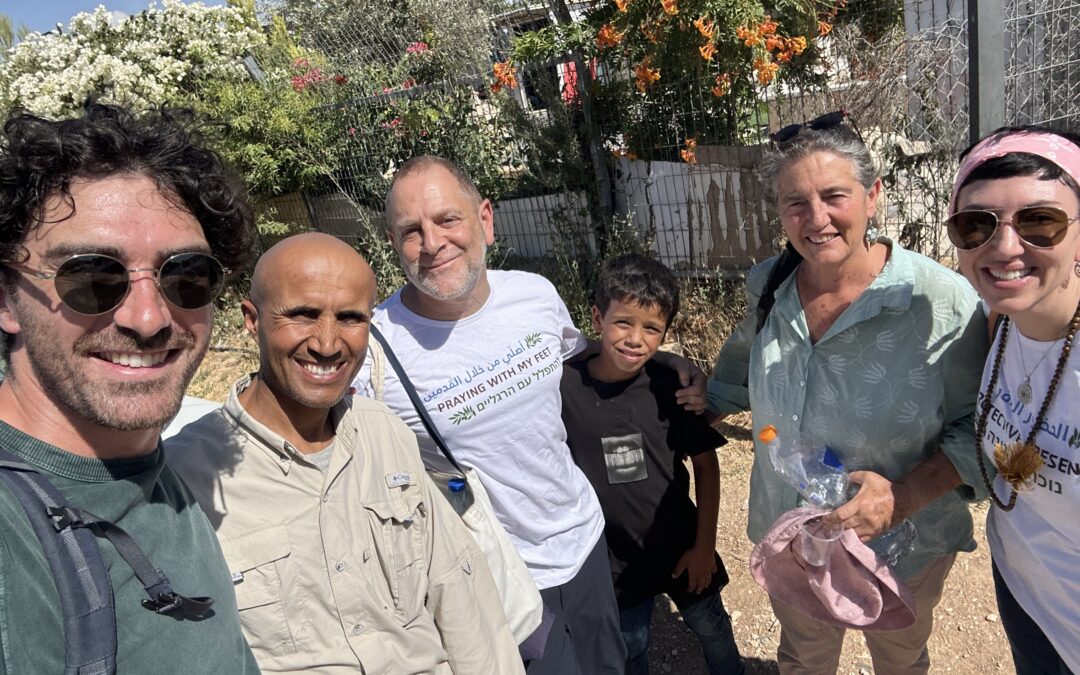
Rabbi Lizzi in the West Bank town of Umm Al Kheir with Zach Witus of New Israel Fund, Rabbi Amichai Lau Lavie of Lab/Shul, and beloved Zohar teacher Dr. Melila Hellner-Eshed of the Sulha Peace Movement. They heard from one of the town’s leaders about the nightly settler violence that is threatening their community.
***
Dear One,
For the past two years, I have spent July studying at the Shalom Hartman Institute in Jerusalem (and also a week-and-a-half in the winter both years, but who’s counting). I am honored to be one of 28 rabbis picked to be in the eighth cohort of the Rabbinic Leadership Initiative, a three-year program for the leading rabbinic voices out of North America to study with one another and with top notch scholars on Jewish thought, philosophy, law, liturgy, ritual, history, and politics. The group includes mainline and modern Orthodox, Conservative, Renewal, Reform, and Reconstructionist rabbis, rabbis who serve on major university campuses, in small town settings, in organizations, and in some of the biggest and most visible synagogues in the world.
The Hartman Institute takes rabbinic enrichment very seriously. While the days are long (8:30 am – 6:00 pm or even 9:00 pm each day!), full of lectures and hevruta (classical Jewish paired learning), they also take physical nourishment very seriously, and there is always an ample supply of gourmet popsicles, fresh fruit, and cold brew to keep us at our best, even when it’s 87 F degrees outside. It’s kind of like rabbi summer camp. I feel very, very blessed to be here, and to get to immerse so fully in Jewish learning, thinking, and makhloket l’shem shamayim — arguing, for the sake of Heaven — the most Jewish form of conversation.
It’s an extraordinary time to be in a committed and diverse cohort of rabbis. We have three rabbis from New York City, all of whom used their pulpits differently when it came to the New York mayoral elections. I got to be a fly on the wall during this debrief, and it was spicy, fascinating, and — most importantly — respectful. We have rabbis from Israel who have kids serving in the army, and rabbis who have been protesting the IDF’s actions in Gaza and in the West Bank for years. And we certainly have significant differences in halakha (Jewish observance)! But rather than give into the urge to reduce people to their opinions on one or two contentious issues and then dismiss them as uneducated, callous, or stupid, an impulse which lets us so easily disregard people with whom we disagree, this intensive is an opportunity to practice loving dialogue across our differences. In a time when pluralistic democracy in America and in Israel feels precarious, this work is especially important.
That’s not the only peacemaking work I have been up to during my time here. On Wednesday, I joined Rabbis for Human Rights and the New Israel Fund in doing protective presence in Umm al Kheir, a town in the West Bank which has been repeatedly attacked by violent Jewish settlers. Protective presence is the collective action of standing between these settlers and the Palestinian farmers and shepherds and even children they are terrorizing in hopes that, with eyes watching and other Jewish people’s safety on the line, those settlers will be less inclined to attack. There are an increasing number of international and Israeli Jewish groups doing this work, offering a counter testimony to the violence which is desecrating Judaism, reclaiming our tradition’s timeless teachings on peace, love of neighbor and stranger alike, and the dignity of all peoples. If you’re interested in being part of a group doing this work, check out this effort and consider joining them with a group from Chicago led by Rabbi Andrea London after the High Holidays.
Thank you for being my spiritual home — I could not go on this trip without your support.
Sending love and many blessings,
Rabbi Lizzi
Hi Rabbi Lizzi,
Thank you your willingness to put your physical safety on the line to protect Palestinians in the illegally occupied West Bank from Jewish settler terrorists. It is a testament to your good character. If someone were willing to pay for my airfare to travel out there, lodging, and food I would love to do the same thing.
But this appalling situation is unsustainable for much longer and needs to be immediately addressed and rectified before it cannibalizes Judaism from within. It is completely insane!
And, mark my words, if this continues, it will only be a matter of time before the settlers start violently attacking other Jews because no one is safe when there is lawlessness. And, in the words of MLK “Injustice anywhere is a threat to justice everywhere.”
Please have a safe trip back to the good ‘ole US of A and “Sweet Home Chicago.”
Shabbat Shalom,
David Hurwitz
(Your Fellow Builder and Friend)