
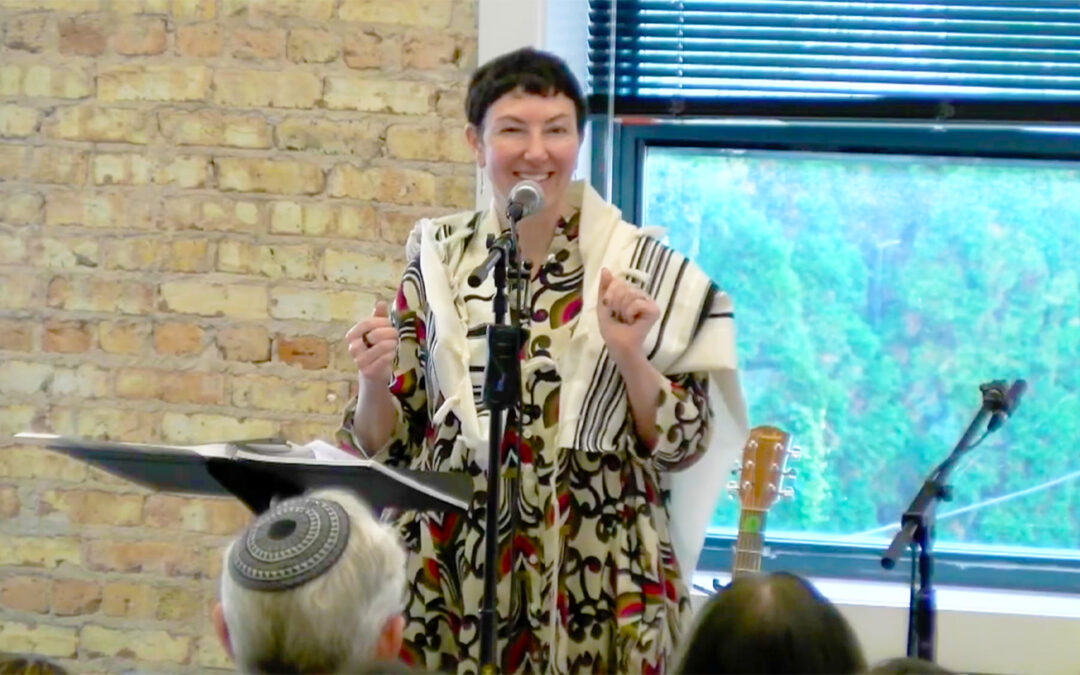
This sermon was delivered at our service on November 1st, 2025. You can listen to this drash on Contact Chai podcast or watch it on our YouTube channel.
****
You already heard about Avram, being chosen from all the people on Planet Earth, to enter into a Covenant with the Creator of the Universe, a covenant where his job is heye brakha to be a blessing, and to teach his family and their kids and their kids for the rest of time, all over the world, to be a blessing. And from the minute we meet him he is challenged with what that means — in story after story about his life and the life of his family, with his nephew Lot, his wife Sarai, and eventually his children Ishmael and Isaac. There are stories of famine and relocating and dishonesty and kidnapping and property disputes and infertility. And his job everywhere he goes, is heye brakha, be a blessing. You could say the whole Torah, after this point, is an exploration of what it means for us to follow in Abraham’s footsteps, to be a blessing.
Repeat after me: Heye brakha. When in doubt, be a blessing.
Now that this moment has happened in the Torah, even the stories that aren’t about Abraham, teach us what it means to be a descendant of Abraham, to be a blessing. Or in some cases, teach us the opposite: teach us what not to do, so that we can be a blessing.
There’s a moment in this week’s Torah reading when Avram and his nephew Lot get into a disagreement over the land they’re sharing, and part ways: Avram stays in the land of Canaan, and Lot journeys eastward, toward a place called Sodom. There are hundreds of places mentioned in the Torah — only one that I know of is described as full of “very wicked sinners” against God: Sodom. So you have to wonder: what was so terrible and wicked about this place? It’s intriguing, right? You may recognize the name because in next week’s Torah reading God tells Avram that God wants to wipe it off the map for its wickedness, and Avram will try to save the city on the basis of the possibility that there are at least 10 good and innocent people there. And spoiler alert, there aren’t 10 good people to be found and the city is destroyed.
So the question remains: what was so awful, so corrupt and so pervasive, contagious… that it touched and affected nearly every person there?
The Torah gives its own explanation, briefly: it describes Sodom as a well-irrigated, well-resourced land, a lush land, referred to a Garden of God. The rabbis of the Talmud, at least a thousand years after the writing of the Torah, describe it as so rich with sustenance and minerals that bread just grew out of the ground, and gold dust shook off the leaves of plants. And the text describes three strangers going to Sodom and trying to spend the night there, but the townspeople threaten to do some violent, unsavory things to these strangers passing through. That particular violence is where the word usually associated with the city of Sodom, comes from, if you’re wondering. Lot protects the strangers by taking them into his house, but the city is destroyed. And it’s on the basis of these few short sentences about what the Sodomites do to these guests, that the Prophet Ezekiel says, the great sin of Sodom is “Arrogance! The city had plenty of bread — ease and tranquillity — yet it did not support the poor and the needy. In their haughtiness, their arrogance,” God says, “they committed abomination before Me.”
Just to repeat, the great sin of Sodom, the abomination, is not actually whatever you may have heard or associate with the name of the city (kids, ask your parents later). Rather, according to the Prophet Ezekiel: “The city had plenty of bread, ease and tranquillity, yet it did not support the poor and the needy.” Their selfishness — was their abomination, and led to the downfall of the entire city.
Now: Raise your hand if you know someone who you might describe as selfish, who may have a lot to give but doesn’t share it? Raise your other hand if every now and again you can be selfish. All of our hands are a little bit dirty. Put them down. But now: raise your hand if you know someone who is unusually generous? Raise the other hand if every so often, you too have been really generous? Put them down. So what I’m seeing here is we, probably like most people in most places, have tendencies toward both selfishness and generosity. And whether or not you’re an official descendant of Abraham, I think we all want to be a blessing, be less selfish, be more generous. But it doesn’t happen on its own: We all need benefit from models for what that looks like, coaching, inspiration, tradition. And we’ll get it wrong sometimes. But it’s important to remember as we look at our own society, even in this room full of really good people, we’re not saints… but we’re not irredeemably terrible either. Even in a room, and a society, where there is selfishness, it doesn’t have to be the dominant feature.
But what if a society were so overrun with toxic selfishness that it was?
So here’s my question about Sodom: How can selfishness become so rampant, so embedded in a society, that it eclipses the good instincts and actually becomes the dominant feature, not just of some people, but of everyone? How can that happen?
The rabbis who wrote later books of Jewish literature also were troubled by this idea that a society could become so corrupt that it warrants destruction (let’s even forget destruction by an outside force like God, and just appreciate that if a society is so corrupt, it will destroy itself from the inside out). The rabbis of the Talmud gave us a little more color about what this selfishness looked like. I want to share a few of these stories with you, can I? From Sanhedrin, a section of the Talmud on systems of law:
The people of Sodom said: “Since we live in a land from which bread comes our of the earth, and has the dust of gold, we have everything that we need. Why do we need travelers, immigrants — as they come only to divest us of our stuff, our property? Come, let us cause the proper treatment of travelers to be forgotten from our land.”
And so it was. It was a strategy from the top. They instituted laws, customs, to not just punish but torment the unsuspecting wayfarer who might pass through. Here are some of those customs — this is all from that same section of Talmud, stories probably 2000 years old:
“They had beds on which they would lay their guests; when a guest was longer than the bed they would cut him down (either from the head or the feet), and when a guest was shorter than the bed they would stretch him.”
Here’s another: When a poor person would come to Sodom, each and every person would give him a dollar, and the name of the giver was written on each dollar. And then they make sure that no one would give or sell him bread, so that he could not spend the money, and then would die of hunger. When he would die, each and every person would come and take his dollar back.
You can hear in those stories: not just selfishness, but cruelty. Delight in the pain of others. The story of the dollar? They’re not even making interest on an investment, they’re just getting to laugh while someone else suffers. It’s so mean. But that was Sodom. That’s why it uniquely earned the infamy of being a place of irredeemable wickedness against God.
Here’s another story: There was a young woman who would take bread out to the starving people in a pitcher so the people of Sodom would not see it. When the matter was revealed, they smeared her with honey and positioned her on the wall of the city, so the hornets came and stung her to death. In another version of the story, the people of Sodom took the girl who had shared her food and burned her alive.
What strikes me about that last story, of the young woman, is that it’s one of a few that’s about kids — mostly girls — trying to help strangers or friends, get the food or resources they need to survive — and be turned into an example, for all to see, to show that no one should take a chance on being compassionate and kind. It showcases the unique challenge experienced by girls and women, who are often more sensitive to the needs of people suffering, and told they’re being weak, or stupid, or don’t understand why it’s necessary for these people to suffer. It sounds perverse, I know, but how many of us have been told exactly that — essentially to sit down and be quiet because your attention to the suffering of the other, whomever the other is, is traitorous, dangerous?
How does a society become so corrupt it destroys itself from the inside? By teaching its children to be afraid to trust their instincts toward goodness, kindness and generosity, and instead to embrace the worst selfishness of their grown-up models. A society being corrupted from the inside criminalizes immigrants for simply existing, and punishes its own people for extending kindness to them, by telling its people that giving to others reduces what you have, that caring for others (whomever they are) undermines your safety. A society becomes that corrupt by telling its children that the ideal when you grow up is to be rich above all else, and to have a lot not so you can share it, but so you can deprive others and laugh at their misery. It’s sociopathic.
And it unfortunately hits very close to home. As our president builds a $230 million dollar golden ballroom on the ruins of the people’s house (to quote Rabbi Steven from last week), and gives gifts of dozens of billions of dollars to countries to bail out fellow authoritarian leaders, all the while 42 million Americans (⅛ of our country’s population) lost access to supplemental nutrition benefits this week that those same leaders will not lift a finger to alleviate or help recover. It’s literally $186 a week for a family to get that assistance, and not one of them can be bothered. One has to marvel at the similarities to Sodom. A land that is lush and has plenty of resources to share with all its inhabitants as well as immigrants, yet in which the leaders horde that wealth and punish, shame, belittle, bully and threaten people trying to balance the scales, or trying to behave with kindness, decency, and humanity.
Emanuel Kant, the moral philosopher, created what he called the “categorial imperative” that was a general guide for how to behave in the world — his version of “be a blessing.” The categorical imperative says that one’s moral compass must be set by the idea that whatever you’re doing must be universalizable. It’s along the same lines as “do unto others the way you’d want to do unto you.” If you’re making an exception for yourself, if you’re treating others as stepping stones and yourself as more important, it will only be a matter of time before the tables are turned and you’re the one being stepped on. So maybe don’t step on people. But we’re still early in the Torah — all God has told Abraham at this point, as we saw in the opening lines of our parasha, is Heye brakha — be a blessing.
So, in a world where selfishness has become the norm, where kindness is labeled as criminal, what does it mean to be a blessing?
I turn it back to you. What does it mean to be a blessing?
I’m thinking about Manny’s delicatessen, the Jewish deli on the South Side of Chicago, and what used to be the neighborhood for Jewish people and commerce in the city 100 years ago, the deli is still there, the neighborhood has changed — and they are offering a free meal, to dine in or to go for anybody who presents their snap benefits card.
I’m thinking about all the free little libraries in which people are now putting canned goods that someone else might come upon and take if they need.
I’m thinking about all of the grocery store owners and farmers market vendors who will eat into their own profits to make sure that their customers don’t starve.
I’m also thinking about a community member of ours, Kalman Resnick, who was the lawyer for RubinTorres-Maldonano, the father of a 16-year-old with cancer who was pulled off the street and detained for the past 12 days, along with 2,800 people in Chicago since Homeland Security and Border Patrol descended on our streets in army fatigues and masks, and though it is just a drop in the bucket, Kalman managed got him out on bail so that he can be with his daughter.
Simple acts of compassion and humanity- wherever you are sphere of influence is, whether it’s a deli or the little library on your street, or the person outside the grocery store, or the phone and whistle in your hand outside your kids, school, kindness, and compassion in the face of a system that is designed to demonstrate cruelty- is what it is to be a blessing, is what it is to be a descendent of Abraham. May we all be worthy of that lineage.
Shabbat shalom.