
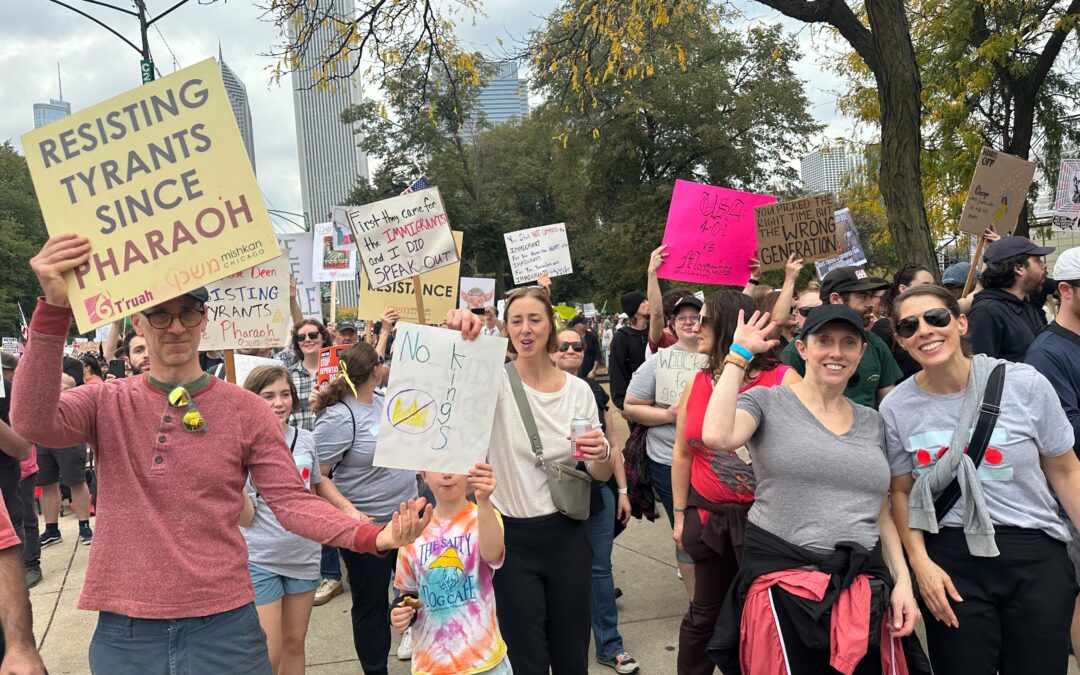
This sermon was delivered at our Friday Night Shabbat service on October 24th, 2025. You can watch this drash on our YouTube page or listen on Contact Chai podcast.
****
Has anyone been to the Art Institute to see Paradise Lost by Raqib Shaw? If you haven’t – go (it’s there until January 19). This monumental painting stretches over 100 feet; it’s really quite something. While Paradise Lost borrows its title from the 17th-century poem of the same name, it’s not a retelling of that work; for the artist (who was born in Calcutta, raised in Kashmir, and fled with his family to New Delhi before relocating to London) it’s a memorial to the many paradises lost over a lifetime: childhood innocence, freedom, a sense of belonging. “This is not just my story,” Shaw explains, “It is the story of each of us, and the story of our times.” Standing in front of this masterpiece, aware of everything happening just outside the quiet sanctuary of the Art Institute, I felt some of the losses of this moment: a loss of safety, a loss of certainty, a loss of the belief that the arc of history will inevitably bend toward justice.
There was a painful irony contemplating a work of art created by someone who has experienced displacement and migration, knowing that only a few miles away masked agents were patrolling the streets of Chicago targeting our migrant neighbors. Since the federal government launched “Operation Midway Blitz” in September, ICE has shown up at homes, businesses, schools, markets, shelters, and hospitals. They have detained hundreds of people without cause (including US citizens). They have assaulted bystanders, arrested reporters, and used violence against protestors. The entire city feels on edge, people pulling out their phones to document every unmarked van that has lingered in one place for too long, the sound of whistles indicating that a federal agent has been seen nearby. Just today, ICE agents were spotted across Lakeview – including just down the street from where we are now, where they unleashed tear gas on the gathering crowd. I grew up believing the story that this country, a country founded by immigrants, was a paradise for any person who dreamt of a better life. Today, the American Dream feels like a paradise lost.
On one panel of Paradise Lost, Shaw includes the Tower of Babel nestled among the snow-capped Himalayas. It is illuminated by fire; whether the half-built structure is glowing with life or burning to the ground is unclear. We actually read about the Tower of Babel this week, at the end of our Torah portion. The parashah begins with a catastrophic flood that nearly annihilates humankind (you might know this story). Noah, who is described as a particularly righteous man, is commanded to build an ark – to serve as a refuge for his sons, their families, and a mating pair of every living creature. For over a year they weather the storm, until the water recedes and they are able to stand on dry land again. Generations later, the descendants of these survivors gather together. “Come,” they say to one another, “Let us build a city, with a tower that reaches the sky, to make a name for ourselves lest we are scattered all over the world.” They begin building the tower out of brick and bitumen. God looks down, sees what they are doing, and decides that this project must be stopped: if this is how they act as one people with one language, God muses, then nothing will be out of their reach. And so God descends, confounds their language, and (as foreshadowed by their rationale for building the tower) disperses them across the globe. And thus, the Torah explains how humankind became many people with many languages.
But what exactly was God’s problem with the tower? It seems absurd that God would fear a united humanity. It is, after all, the hopeful promise of our tradition, this is what we’re working toward: a repaired world, where we peacefully coexist as one human family (we will sing about this at the end of services in the Aleinu. Rather, it must be what the people sought to do with the tower. Some have proposed that it is a matter of hubris (the people say: let us make a name for ourselves), humankind believing that they could bridge the natural divide between heaven and earth. Others have said it was a violation of God’s command to Noah and his family to p’ru ur’vu shiratzu ba’aretz, to be fruitful, multiply, and spread out over the earth – rather than remain fixed in one place (the people say: let’s build this thing, lest we are scattered).
Or maybe the problem wasn’t with the tower itself, but how the people went about building it. There is a story told by the rabbis, that because there was no stone to use for construction the people had to painstakingly bake bricks until they were hard enough to bear the immense weight of the project. The tower had two steep ascents: one on the east side and one on the west side. Laborers slowly took bricks up the east ascent and carefully walked down the west ascent. Now if a person fell to their death while climbing, the other laborers kept working and said nothing. However, if a brick fell – everyone would stop what they were doing and weep, crying out: “Oy lanu! Eimatay ta’aleh acheret tachteyha? Woe is us! When will another come in its stead?”
Here’s the thing: there is nothing wrong with their dream of building something strong and durable. The people grew up hearing stories of a flood that nearly killed all of humankind. And so they want to build a city, with walls high enough to protect them and a tower that would stand above the highest waters – a beacon that would guide them home, should they be separated and lost. Let us make a name for ourselves, they say – but the word shem, in Hebrew, is not simply being known, some kind of fame, but legacy. May we leave a legacy, they say, for all who come after us so that they might say, no matter what storms they may have to weather: those people did something great.
Yet in their desire to do something great, to build something larger and more lasting than any of them could have accomplished as individuals – they forgot the value of the individual. The tools of the trade became more important than the people who bore them. They no longer saw the humanity of those standing right next to them. They sought greatness, a tower that would reach the heavens – and for what? The people set out to build a city that would be home. But when the project of building this city became more important than the people who inhabited it, then it was right that the structure should crumble and fall – brick by faceless brick. The sin of Babel was not hubris or defiance of the divine order, but dehumanization. It is, in some ways, the first example of idolatry in the Torah: people worshipping a thing, rather than cherishing God’s most fundamental way of showing up in the world – which is through us, human beings created in the divine image.
This, of course, is what makes this moment in history so heartbreaking – to see people treated as incidental, as contingencies to the equation rather than as human beings. Dehumanization is also the sin of our time. In its quest for greatness, the Trump Administration has employed a callousness that chips away at the moral foundations of this country. And we are seeing – as millions stand to lose access to SNAP (or the Supplemental Nutrition Assistance Program), as Medicaid is gutted and the cost of living skyrockets while a golden ballroom is being erected on the remnants of the People’s House – how the whole structure has started to buckle, teetering on the edge of collapse.
We see the fault lines of dehumanization breaking apart our city. By seeking out “illegal aliens” (their term, not mine), our federal government refuses to recognize that the people they are targeting are human beings. People, like you and me. This posture has real impact, in how ICE treats the individuals they assault and they detain. We know that there is a direct line between dehumanization and violence; the conditions of detention under ICE are intolerable, even deadly – a moral stain on our nation and something that we, as a country, will have to answer for.
And these are human beings: Ruben Torres, a father caring for a child battling cancer; Laura Murillo, a woman who has been selling tamales on the same street corner for years; a teenager on his way to high school; and hundreds more. Human beings who are part of the fabric of this beautiful city. And this fabric is being torn apart. People do not feel safe. Businesses are closing. Folks are missing work. Children are absent from school. I don’t mean to be alarmist, but sometimes it feels like everything is on the verge of falling apart.
To be clear our immigration system was already broken. It needs fixing. Our legislators have tried and failed, again and again, to work together to solve this problem in ways that are humane, that help people who have been here many years, people who have careers and communities in this country achieve legal status, or facilitate the safe arrival of asylum seekers, or simply make the process more efficient and more accessible. And in their failure, our elected officials have given this administration the opportunity to choose callousness and cruelty, to instill fear and terror, to uphold ideology over our shared humanity, rather than actually solve America’s systemic immigration challenges.
So how do we keep this whole structure from toppling down? Because I do still believe in the promise of this country. I don’t think it has ever been realized, but the dream is there: an America that welcomes the tired, the poor, the huddled masses yearning to breathe free; a country of immigrants, that honors and lifts up the people who were here before us; grand cities and small towns of many people speaking many languages – this is the future I want to build (and the one I imagine God was envisioning, when God scattered humanity instead of letting them construct a tower on the bodies of fallen workers). This is what I want the name “America” to mean. This is the legacy I want us to leave behind.
One response to policies of dehumanization must be an insistence on the humanity of other people. This begins with how we approach those who are being spoken of or treated as a problem. One of the best ways we can support our migrant neighbors is to show up: to bear witness, of course, to moments when they are being targeted and ensure that they are not facing ICE alone. But also to be present in their neighborhoods (which, let’s be honest, are also our neighborhoods). To eat at their restaurants. To buy things at their stores. This not only provides essential economic support when business has been compromised by concerns for safety, but gives us the opportunity to build relationships with the other people who also call this city home. Mishkanite Aliza Becker has made a beautiful and helpful document to give us ways to do this here in Chicago; it’s in our newsletter from this past week. We must refuse a rhetoric of us and them, even if the distance between the two seems benign. It’s in our power to close that gap.
And here I’m going to propose something even more radical (please bear with me). We must also insist on humanizing those who have been twisted by the lies of hatred and bigotry. It is tempting to project evil onto the masked faces tearing apart families and disappearing people off the streets of our city. And don’t get me wrong, what they are doing is evil. But while we can and we must condemn their actions, we cannot and we must not utilize the same dehumanizing rhetorical strategies that they do. With respect to Audre Lorde, in this case the tools that built the master’s house can certainly tear it down – but the structure will collapse on top of us all. If we are going to build a better future, if we are going to create something that lasts – we must do it another way. Because behind the masks, as hard as it is to see sometimes, those agents are also human beings. So are the people designing these policies.
Now I want to be very clear: this is not to excuse their actions. What ICE is doing in our city, and in places across the country, is a moral wrong – one that compromises the integrity of our nation’s founding promise and is an affront to the ethical call of Judaism as well as the teachings of our neighboring faith traditions. We absolutely must hold the perpetrators of harm accountable for their actions. We can and should be angry about the treatment of our neighbors. So I am asking you – protest and resist in whatever capacity feels right to you (and let me know what you’re doing, so I can join). And when the time comes, we will seek restitution for the damage that has been done. But as we resist the inhumanity of what they are doing, we must not give in to the temptation of dehumanization.
Shortly before the raids started in Chicago, I read an article in The Atlantic about an ICE hiring expo in Dallas. Like the author, I was morbidly curious: who could do such a thing? But as I read stories about the people showing up to wait in line and submit their resumes, I realized that they were driven by the same fears and concerns that I feel looking at the crumbling structure of this country. They also lived in a paradise lost. They are also watching their livelihoods shrink, their grocery bills go up, their opportunities disappear, and are left wondering what tomorrow will look like for them and for their kids. And like the people of Babel, they want to build something better: to make America great again, a lasting legacy of peace and prosperity for future generations. The problem is that somewhere along the way, they were told the convenient lie that someone else was to blame for this problem – and that removing those people would be solution for fixing it.
We cannot give into that lie either. And it is an easy lie to believe: that one person or one group of people is the source of all ills. How convenient would that be, if it were actually true. But it is not true. A better future for us does not come at the expense of a better future for them – however we might draw the line between us and them, and these lines have been drawn in many directions. We must not build our own tower (or golden ballroom, for that matter), indifferent to the suffering of the people we don’t like or disagree with. If this structure is going to last, we must build it together – as challenging as that might be. And it is challenging. But I am going to challenge us.
So in addition to protesting and advocating and bearing witness, let our response to this moment also be rehumanization: a radical reclamation of the humanity in ourselves and in others. This means we must look behind the distortions of anger and division to see each other as people, human beings who have a stake in this fight and are scared about what tomorrow will bring. It is a painstaking, painful, and often inconvenient process, to slowly correct the lens through which we and others view the world. It means speaking out against dehumanization. It means standing up, sometimes at great discomfort, to friends and family and coworkers. For some of us, it means putting our safety on the line to fight for what we believe in. And it also means looking at ourselves, to examine our own biases and recognize where we have allowed our hearts to become hardened.
Sometimes rehumanization can be as small as looking the stranger in the eye, learning their name, maybe even hearing a bit of their story. This stranger might be your favorite barista (or better, your least favorite barista), or the person who cleans your house, or the crossing guard outside your child’s school, or the individual who asks for money on the street corner every day. It might be your neighbor, who you never got around to meeting, or someone in a neighborhood you have never visited. It might be someone who agrees with you, but it also might be someone who does not. To see the humanity in another person may seem like a small thing. But this small thing can be a radical and incredibly holy act, especially in this moment. It takes effort and it takes time. But brick by brick, we can build something that will resist the flood of dehumanization – not a tower, but a lighthouse guiding us all back to this simple but profound truth: we are one human family. It is either all, or none. And I choose all.
Beautiful and much needed!