
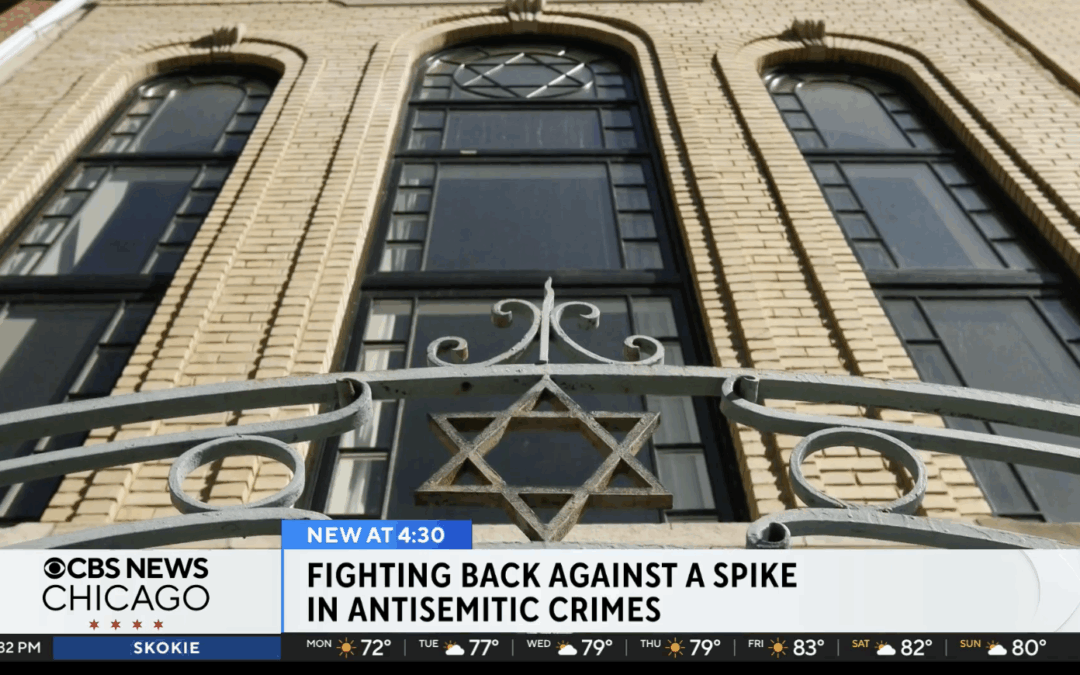
On September 8th, 2025, Rabbi Steven spoke in City Hall during a public hearing on antisemitism held by the Chicago Commission on Human Relations. These are his remarks.
****
Thank you for the honor of speaking today. My name is Rabbi Steven Philp and I have the privilege of serving as one of the rabbis of Mishkan, a progressive post-denominational Jewish spiritual community. I am also a licensed clinical social worker.
The impact of anti-Jewish hate crimes is both real, in the sense of its tangible effect on people and places, and perceived, in the sense of our awareness and concern about their occurrence. I want to comment on the latter: perception is important, because it informs feelings of safety and belonging.
I work for a community guided by the value of radical inclusivity, created in part for people who have historically felt out of place in mainstream Jewish institutions — this includes interfaith households, LGBTQ Jews, Jews of Color, Jews living with chronic illness and disabilities, etc. We are also a community with members who identify as Zionist and members who identify as anti-Zionist. As a consequence, many if not most of our members belong to multiple communities. For example, outside of Mishkan, I spend a lot of my time in progressive advocacy spaces and the queer community.
I have sat with many community members who increasingly feel like they are not welcome or not safe in these other spaces. They feel like incidents of anti-Jewish hate are not taken seriously, or that their peers believe (whether stated or implied) that these are legitimate responses to war in Israel and Palestine. A recent survey of LGBTQ Jews by Eshel, an organization that supports queer folks in Orthodox Jewish communities, found that over the past year 4 out of 10 Jews have opted out of LGBTQ spaces because they no longer feel welcome or safe. This is at a moment when the queer community is increasingly under attack by the current administration; community is an essential lifeline in difficult times.
The problem is that not all of these individuals are able to find welcome or solace in Jewish communities either. For example, anti-Zionist Jews may find that they are not welcome in most Jewish institutions while also being pushed out of progressive advocacy spaces. LGBTQ Jews who no longer feel safe in queer spaces may not necessarily find the support and acceptance they need in Jewish spaces. Jews of Color who find that anti-Jewish hate is not being taken seriously in the communities of color they belong to may also face racism and other forms of discrimination in Jewish spaces. These are all conversations I have had with community members.
The result is the feeling of isolation, of being caught in between, of belonging nowhere, of standing alone while remaining vulnerable to the anti-Jewish hate that we have noted is on the rise. Places where people can bring their whole selves are becoming increasingly rare, and while I as a leader have endeavored to create a community where these individuals can show up and feel safe — I cannot do it alone. I would like to reiterate some of the recommendations that my colleagues have suggested: robust education on antisemitism and other forms of hate, mental health support, and continuing to build coalitions, especially across disagreement, because relationships are essential for understanding.