
This sermon was delivered at our service on October 16th, 2026. You can listen to this drash on Contact Chai Podcast or watch it on our YouTube channel.
****
As we get back into the rhythm of our calendar post-High Holidays, our Torah cycle grounds us in its classics, in memorable epics of creation stories, that have a cadence of their own. Yehi or, vayahi or — let there be light, and there was light. Vaiyahi erev, vaiyahi voker, yom echad — there was evening and there was morning, a first day. And then a second. And then a third. Grand-scale stories are full of recurring lines and motifs — there’s comfort in familiarity. These texts lend themselves to retelling, and usually make for wonderful children’s stories.
This week’s parsha, Noach, is perhaps the most beloved of these, or at least the most retold. There are countless picture books and coloring sheets and even a catchy song all featuring Noah saving the animals two by two, (by twosies twosies) as they walk up into the ark and hunker down for 40 days. After seemingly endless rain, Noah sends out a dove who brings back an olive branch as proof that the storm is over, and the animals march out under a rainbow of God’s promise to never flood the earth again.
It’s a classic. And if you stop reading at the rainbow, it’s a happy ending. But the story keeps going. And in the context of the entire parsha, we find that it’s not a happy go lucky children’s tale, but rather an in-depth look at humanity in the face of the destruction of the world.
Interestingly, our tradition is far from the only one with a harrowing flood story. We find them in religions and cultures around the world — in Hinduism, in Greek mythology, in Native American creation stories — and many of them feature a hero who builds a ship and survives a world-ending storm. And this makes sense — with so many ancient cities next to bodies of water, there was likely nothing more frightening than the idea of a life-sustaining river morphing into a life-threatening one.
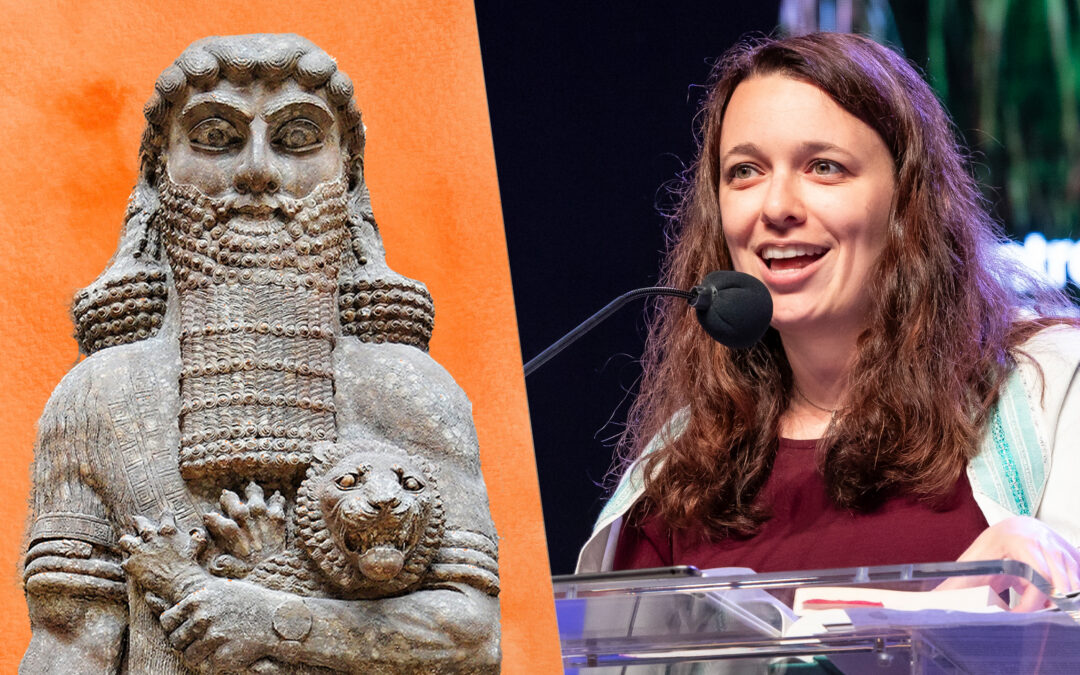
Or perhaps there really was a Great Flood, a cataclysmic disaster that reshaped the land, where humanity watched as everything fell apart gradually, and then all at once. As some of you shared in Morning Minyan this week, the best case we have for this is the seeming corroboration of Genesis in the Epic of Gilgamesh, the earliest story ever written. Like Genesis, it’s set in Mesopotamia along the Tigris and Euphrates Rivers — and that’s just where the similarities begin.
In the Epic of Gilgamesh, the Sumerian gods complain that humans are too loud and so they plan to wipe out the Earth with a flood. If you’ve ever lived in an apartment with thin walls, maybe you empathize. Just as Noah is warned of the flood ahead of time, in Gilgamesh one of the gods confides in a king, Uta-Napishtim, who builds an ark set to exact specifications for his family, animals, grain, and craftsmen. After a week onboard, Uta-Napishtim sends out a series of birds to see if the flood has ended, as does Noah, and when he reaches dry land, he performs sacrifices, like Noah, in gratitude for survival. However, unlike Noah, Uta-Napishtim is rewarded with immortality, and becomes a powerful divine-like figure, making Gilgamesh jealous. Gilgamesh tries and fails to become immortal too, and travels to the historically important city Uruk, where he’s comforted by the permanence of the city walls. Gilgamesh reflects that it’s through grand buildings and innovation that mortals achieve immortality.
Our tradition offers a very different perspective than the Mesopotamian story. The Torah does not take destruction lightly, so Noah’s ending is far more troubled. He plants a vineyard and drinks heavily, with commentary suggesting that Noah relied on wine to cope with having witnessed disaster. He is assaulted by his children in a vague but disturbing passage, and the generations stretch on, led by a group moved by hubris to build the Tower of Babel and touch the sky. We read on for a polemic refuting power, scoffing at the fleeting nature of human control.
Where Gilgamesh finds solace in the imposing buildings of the empire, Genesis finds ridicule, noting that while people think the tower reaches the heavens, it’s so small in the grand scheme of things that God actually has to climb down to see it. God destroys the tower and confounds the people’s speech so they can’t understand each other — balal, confuses — which mocks the name bavel — Babylon, where the city Uruk and its tower were historically located. This is a story that pokes holes in the legends of a mighty empire.
Several rabbis of the Talmud, however, argue that the construction was actually reasonable. Remember, these were the people who had survived the flood — perhaps, the rabbis offer, the tower’s height was an attempt to burst through the lining of the heavens so that the water would leak out predictably, preventing another flood. A midrash similarly suggests that the Tower was intended to reach the sky, not to burst the heavens, but to act as scaffolding to hold them up so that it might never storm so terribly again. And the historian Josephus explains that the Tower was innovative in being too high for future floodwaters to reach, the bricks sealed with a waterproof mortar to protect those inside.
These protective measures are understandable, and we who live in an era of modern catastrophe ought not to be surprised. We too carry with us a sense of foreboding that the floodwaters are rising — with every breaking news story, with every school shooting, with every act of war. We are over-exposed to panic and pain, and it comes with risks. In any underlying sense of danger, there’s a need to build contingencies, to protect ourselves and each other. When grounded in reality and care, this can save the day. But when fear is separated from the consideration for others, we cascade into extremism.
The Talmud says that it’s not the construction of the Tower that angered God, but the way the people went about it. In their haste and determination to finish building, they lamented any damage to their bricks but did not grieve when their workers died in the dangerous conditions. They built not just a tower, but a totalitarian system that prioritized power over people. It was a society whose thirst for control harmed everyone.
The generations listed as present in this era end with Abraham, who grew up in the neighboring Mesopotamian city Ur. The rabbis write that young Abraham passed by the Tower of Babel regularly, and when he witnessed the heartlessness of its builders, he urged them to stop building it, but was thoroughly ignored. Almost as if to stop and empathize with others after neglecting them for so long was too much.
We know that next week, we’ll read about Abraham going forth, away from this town in Mesopotamia, to embark on another journey and establish our heritage. He will encounter more disasters, and he will navigate them differently than the people do this week, by fighting for the dignity of those impacted. But our story isn’t there yet. This week, we’re sitting with Noah in his suffering after the storm. And we’re building a tower that falsely promises immortality, and we’re witnessing the pain of those swept up in its cause. Our story is in a moment of overwhelm.
The story gets better. We’ve read it before — we just finished the whole scroll two weeks ago — and we know that it’s going to be okay. But this moment is the heart of the storm. And what matters most is how we show up for each other as it rages on.
The Bible scholar Everett Fox is also fascinated by these creation stories. He notes that the biggest difference between Genesis and Gilgamesh is not the plot points, but the core theology behind them. The Mesopotamian gods view humanity as disposable slaves to the divine, a nuisance posing no great loss. In our story, however, human beings may not “live up to God’s expectations, but are nevertheless considered capable of doing so.” This seemingly small difference has huge theological ramifications. Yes, God in our story is depicted as quick to anger, as all ancient deities were, and brings on a flood, as most ancient deities did. But unlike in neighboring cultures, our God grieves this destruction — vayit’atzeiv el libo — with a heart full of sadness at the state of the world. This shift to a God who believes in humanity, and believes in us — a scrappy people who, with a few brief exceptions, have historically been without an empire — is shocking.
We do not have towers, we do not have kings. We have sukkahs that are permeable, a Mishkan that is portable, a scroll that we carry in our arms. Our liturgy leans into this impermanence, into an openness towards the world. It overflows with blessings for change and transitions, from night to day and day to night, and month to month, and year to year. Our agency is through being grounded in the present, and seeing it as it really is, rather than in how it ought to be controlled. Our agency is in taking care of each other through the chaos.
We are the witness-bearers of our age, each of us an unlikely hero in the epics of our own lives. For all the times we feel like Noah, burnt out and devastated and eager to numb ourselves, we get to grow into Abraham, walking alongside a God who believes humanity can heal each other and heal the world.
We’ve inherited an incredible story, unlike any other. A story where God has faith in us, even in times where our faith feels lost. As we are called onto our journeys, may we protect each other and look out for each other, as we find faith in us, too.
Shabbat shalom.