
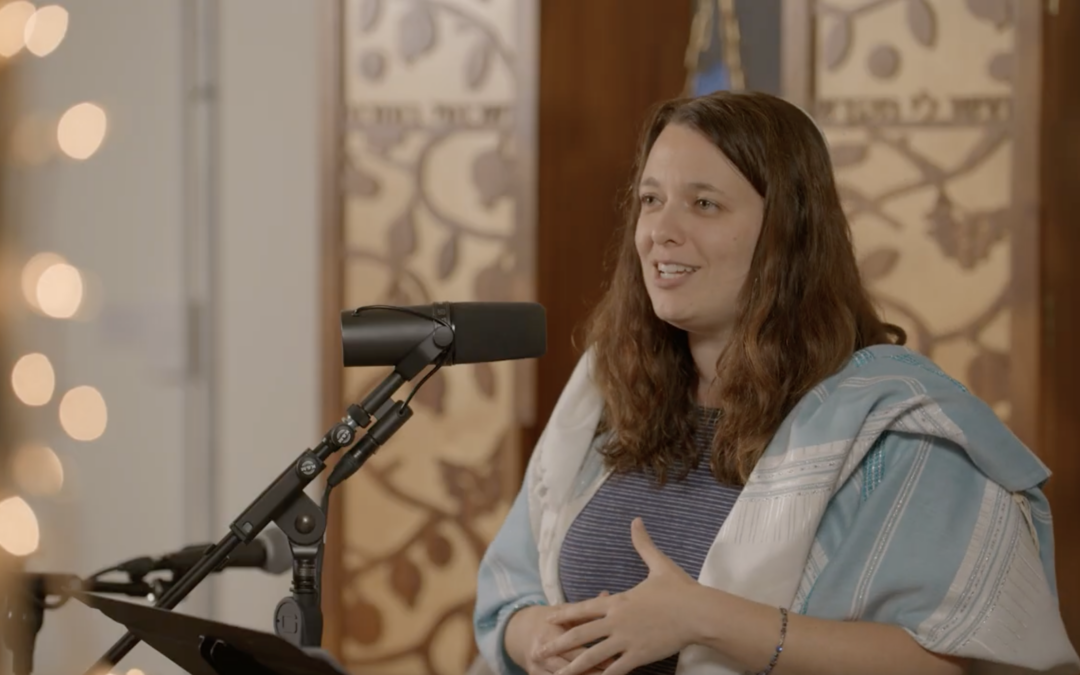
This sermon was delivered at our Erev Rosh Hashanah service on September 11th, 2026. You can watch this drash on our YouTube channel or listen on Contact Chai Podcast.
****
It’s so nice to be here with you all. It’s crazy to think that it was eleven years ago on Rosh Hashanah when I first discovered Mishkan, which led me to the Davening Team, which led me to rabbinical school, which, wonderfully, gratefully, led me back here. It’s been quite the journey back — I’ve been in tiny rural congregations and ones in major cities, I’ve served in interfaith housing coalitions and in war zones, I’ve spent so much time in camps and classrooms and a Jewish rehab center. But it’s at Mishkan where I feel most at home.
As a rabbi for all sorts of communities, I’ve been asked all sorts of questions. Questions about wedding ceremonies or Hebrew grammar or the latest political scandal. Sometimes questions about more personal issues — grief, relationships, major life changes, addiction. But interestingly, the questions that people seem most embarrassed to ask me are not about sex or drugs or anything stereotypically scandalous. The conversations that people are most likely to close the door for or lower their voice to a whisper for are questions about prayer.
A lot of people, especially Jews, feel uncomfortable or uncertain about prayer — and understandably so. Jews in the modern world and especially progressive Jews in America don’t really talk about prayer in our day-to-day lives, so when a moment arises where we feel we need to pray, not from a text but from our hearts, we’re often left without a vocabulary for doing so. The words that come to mind are then limited to the prayer language floating in our cultural zeitgeist, the words that most Americans use in prayer, which is to say, Christian or Christian-leaning, with imagery that doesn’t describe how we feel or fit our theology. So we’re left feeling uncertain or stupid or silly in a time when we really need to feel held.
And even when we can push past that, and really pray in a moment of conviction or desperation, we cannot guarantee the prayer’s outcome. In the conversations that most pierce my heart, someone will confide some great challenge or horror they’ve experienced, and say “I prayed… I begged God. And my prayer didn’t work.” My prayer didn’t work. How is anyone to respond to that? It’s my job to respond to that. And yet, haven’t I also been through challenges where I prayed to no avail? Haven’t we all witnessed moments where the cruelty of the world seems to work against every notion we’ve been taught about God?
This sort of despair leaning into nihilism could be a symptom of the many crises saturating our modern world, but it’s actually an ancient feeling, and one that our tradition is quite comfortable grappling with.
So many of our texts play out on a backdrop of vulnerability, featuring those who feel abandoned by God, and those who yearn for language to match their inner state. This struggle to connect authentically with the Divine is woven into the Hebrew Bible, and it’s a core theme to the High Holidays. Even as we move through this weekend celebrating the creation of the world, we’ll find that our Torah service tells the story of how Jews pray by noting the inflection points of prayer throughout time.
We’ll read four stories from the Torah and Haftarah over the course of Rosh Hashanah, the most famous (or infamous) of which is the Akedah, the Binding of Isaac, where he is nearly slaughtered in sacrifice by his father Abraham. This story is deeply troubling to us today, and it has troubled Jewish interpreters for at least 2000 years.
But if we go back 3,000 or even 4,000 years ago, before the time of our rabbis, we find that the ancient cultures that ruled over Mesopotamia and the Near East – the Assyrians, Moabites, Canaanites, Ugarites, and more — had their own religious practices from which ours grew. In this region and elsewhere around the world, the prominent theology saw children as especially skilled conduits of information, and closer to the Divine than adults. Child sacrifice therefore was a common way of communicating desires and showing allegiance to the gods. It was a precursor to prayer.
So we see in our sacred text, put to parchment around 3,000 years ago, that God follows suit with Near Eastern tradition, and asks Abraham to prove his allegiance by sacrificing Isaac. Except then God does what would have been absolutely shocking to this ancient audience, and stops the child sacrifice mid-ritual. It’s a major plot twist.
With the ram as the replacement for Isaac — the ram whose horn we use as a shofar — our ancestors distinguish themselves from others and forbid child sacrifice outright. And so theology shifts instead towards animal sacrifice as the main way to communicate with God, and remains that way for another thousand years, fulfilling the same human desire for divine connection, with the Temple in Jerusalem as its main hub.
And we progress through time, and the shifting geopolitical tides see the region cycle through multiple names and empires, until we reach the year 70, and the Romans destroy the Temple, making animal sacrifice no longer a feasible option.
What is a people to do? How will they communicate with God? What could possibly be the outlet for their despair and uncertainty?
The answer comes to us in the Rosh Hashanah Haftarah, when we read from the Book of Samuel on Day One. Though the story is set several centuries before the Temple was destroyed, it lays the foundation for the path forward once Judaism has to reshape itself in Roman rule.
The reading introduces us to Hannah, who every year travels with her husband up north to Shiloh, where there’s another temple site, to take part in the sacrifices and feasting that were seen as surefire ways to stay connected to God.
By the time our story takes place, Hannah is despondent. All she wants is a child, and she has done every ancient ritual and sacrifice that should guarantee her fertility. For years, she has done exactly as she is supposed to do, until her family starts to mock her for seeing no results.
As the annual community sacrifices go on and everyone else enjoys ritual feasts, Hannah sits on the steps of the temple and weeps. Completely distraught, she mumbles to herself as she cries, alarming the priests and temple attendants who are keeping watch. One of them, Eli, approaches dismayed, and completely misreads the situation, saying – Ad matai tish’takarin? Hasiri et yayin mei’alayich! — “How long will you be drunk? Pour out your wine, sober up!”
Except Hannah is not drunk, and she tells Eli so. Lo sha’titi – va’esh’poch et nafshi lifnei Adonai. “I did not drink — I am pouring out my soul to God.”
Our sages say that it is this moment that serves as our model for prayer. And when the temple is ultimately destroyed and animal sacrifices are no longer an option, the rabbis flee Jerusalem to set up their own schools, rooted in the study of text, using sacred literature to stay connected to their past, and using Hannah’s story as a guide for how to pray. This is where we get Rabbinic Judaism, the same theological model we use today.
The rabbis set and debate rules over the minutiae of prayers — when to say them, who can lead them, how to get a congregation to focus. But most of all, the rabbis are concerned with intention. Intention matters in prayer and mitzvot, to the point that they say on Rosh Hashanah if you walk by a synagogue and happen to hear the shofar blast, it doesn’t count as fulfilling the mitzvah, because you need to intend to hear it. Your prayer and your heart need to be aligned.
In his speech The Spirit of Jewish Prayer, Rabbi Abraham Joshua Heschel says that “Prayer is the microcosm of the soul. It is the whole soul in one moment; the quintessence of all our acts; the climax of all our thoughts.” It’s a beautiful notion, and one that we may experience at certain moments of our lives — an overwhelming sense of the Divine that’s at once grounding and transcendent. But it’s hard to jump into that state in the day-to-day, especially for the many people who experience prayer as a mental block or a blank page.
But modern theologians have helped us here, by looking at our liturgy as it relates to daily life, and suggesting that if we’re struggling to pray, we can sort all prayer into simple categories. Rabbi Marc Gellman, when interviewed for New York Times Magazine, offered that “when you come right down to it, there are only four basic prayers. Gimme! Thanks! Oops! and Wow!… Wow! are prayers of praise and wonder at creation. Oops! is asking for forgiveness. Gimme! is a request or a petition. Thanks! is expressing gratitude.” Gimme, Thanks, Oops, and Wow. That’s our entire High Holiday machzor. And that’s how the rabbis thought of the siddur every other day of the year too.
Yearning, gratitude, remorse, amazement. Interestingly, these most basic components of prayer imply that there’s something perpetually unexpected about the present, no matter when in time a prayer is said. Needing and regretting, delighting and wondering – these all indicate a significant lack of predictability in our lives. Which isn’t wrong… the greatest fallacy we tell as humans is that we have total control. To be human is to be very, very vulnerable.
Our other Rosh Hashanah readings address this as well. In the Day One Torah service, we hear the story of Hagar, who is Sarah’s servant, an immigrant and the mother of Abraham’s first born, Ishmael. Ishmael — Yishma El, “God hears” — is so named because God hears Hagar’s misery when Sarah first mistreats her. After Sarah evicts Hagar and Ishamel to the desert, they journey as far as their water allows, until Hagar realizes that Ishmael is dying of thirst. She inwardly begs not to witness his death, and walks until he is out of sight, where she breaks down in grief. Suddenly, an angel appears and comforts her: God has heard the boy’s cry from sham, from over there. Or, since the Torah doesn’t use vowels, “God has heard the boy’s cry from shem, from his name.” Ishmael is destined to be heard by God since birth. And we are, too.
God lifts up Hagar’s eyes, and she sees a well, and runs to bring Ishmael water. It’s a miracle, but there’s nothing magical about it. The well was there the whole time, like the ram was when Abraham raised his eyes. The ram and the well are part of the scenery. Abraham and Hagar just had to notice them.
Prayer helps us look up. Up [ie to God] but also up [ie out], looking at the world around us, in all of its brokenness, to see it as it really is: the overshadowing horrors and the goodness hidden in plain sight.
Heschel writes that prayer is motivated by the sense of not feeling at home in the universe, and that in a world with so much suffering, God does not feel at home in the universe, either. “God’s presence is in exile, the world is corrupt, the universe itself is not at home…. To pray” he writes, “to pray means to bring God back into the world.”
The last text we’ll read in the Rosh Hashanah Torah service speaks exactly of that. It’s a lesser-known Haftarah passage usually only read on Day Two, and it’s pulled from Jeremiah, who is our tradition’s most depressed prophet. Jeremiah lived in an era of intense greed and injustice. He bore witness to the fall of Jerusalem, and endured repeated persecutions. He weeps often and sometimes wishes he was never born. But on Rosh Hashanah, we read of his conviction that a better world is on the way. Jeremiah references Rachel mourning her children in exile, and he shares news of their return. Bivchi yavu… v’hafachti evlam l’sason v’ni’chamtim. “In weeping they will come, and I will comfort them and gladden them in their time of sorrow.” It’s a shift from despair to hope, another desperate parent whose child thrives against all odds. Where the other Rosh Hashanah texts depict prayer as a reaching out for connection, Jeremiah conveys the reply: Racheim arachamenu, God says — I will reach back to them in love.
Of course, love does not guarantee that nothing bad will happen. In the daytime High Holiday liturgy, Unetaneh Tokef famously presents all the ways that things can go wrong in the coming year. Who by fire, who by water — it’s a text that dwells in the anxiety of the unknown, and then insists that “tshuvah u’tefillah u’tzedakah ma’avirin et ro’ah hag’zeirah.” Usually translated as tshuvha, repentance, and tefillah, prayer, and tzedakah, charity, will avert the harsh decree. But if we look at the word “ma’avirin” we see the root AVAR, meaning to pass, to move through. “Tshuvah u’tefillah u’tzedakah ma’avirin et ro’ah hag’zeirah” — repentance and charity and prayer don’t prevent catastrophe — they allow us to move through catastrophe.
Prayer is not a magic wand that makes challenges disappear. Prayer is an orientation that grants us the spaciousness to look up. To see how the world that frightens us can instead be the world that holds us. A world with a well. Or a ram. Or tears that inspire others. A world where terrible things have happened, and we know that it’s going to be okay.
This is the promise of the High Holidays. Yes, we celebrate and yes, we start over and yes, we make amends. But we also tell the story of why we pray. A story that is ancient yet ongoing, a story that we inscribe ourselves into. One where our circumstances go from insurmountable to inspiring, and our lives transform. A new world is created for us as soon as we choose to orient towards it. It just starts with a prayer.
Shana tova.