
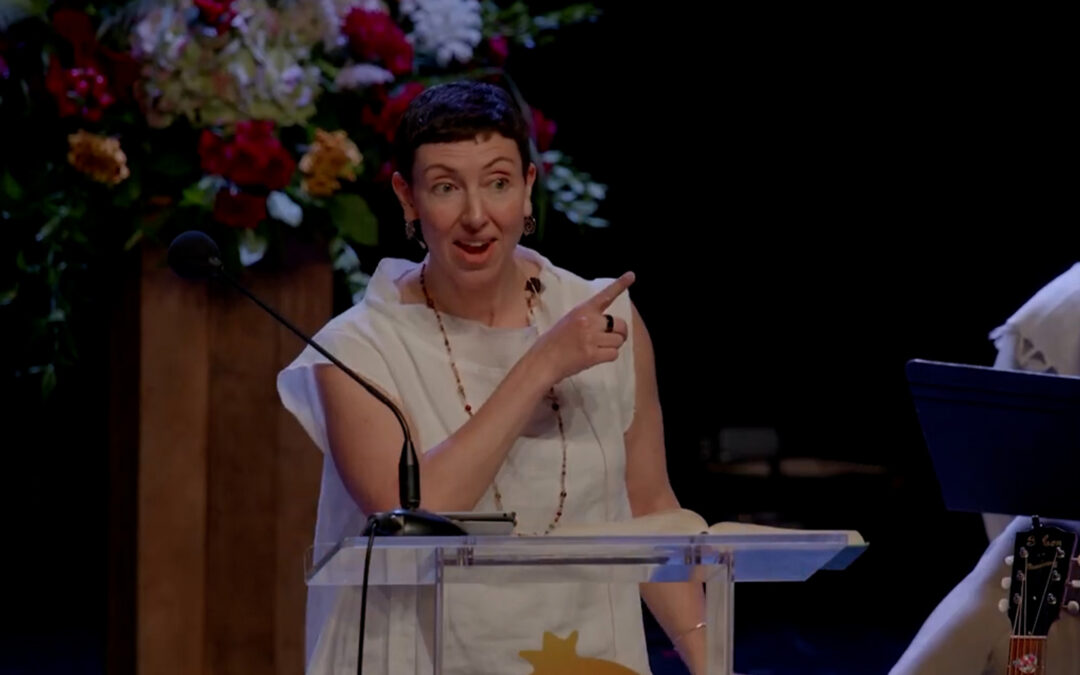
This sermon was delivered at our 5786 Yom Kippur service. You can listen to this drash on Contact Chai Podcast or watch it on our YouTube channel.
****
לוּלֵי תוֹרָתְךָ שַׁעֲשֻׁעָי אָז אָבַדְתִּי בְעָנְיִי
Lulei Torat’cha shuai as avadati b oni (sing)
If Your Torah weren’t my delight, my plaything, I’d have perished in my misery.– Psalms 119
I gave a sermon on Rosh HaShannah that dwelt, at least in part, in misery. Today I’d like to dwell in delight, specifically the delight of being Jewish. Yom Kippur is about embracing positive change, and joy, or to quote this psalm, delight, is recognized by organizational psychologists and justice movement leaders alike, as an essential motivator toward embracing positive change. Also, ask any parent who’s ever fed their vegetables by turning the spoon into an airplane.
There is much to delight in, in being Jewish. Noodle kugel, klezmer music, the Hanukkah Song by Adam Sandler, any university’s Latke Hammentashen debate. We delight in Jewish actors and comedians and musicians and sports ball players. I’m sure from specific sports… I don’t really follow them.I’m a rabbi, so the specific delight I’m taking in being Jewish these days stems from knowing that our tradition guides us toward values and ideals that are different and distinct from the ones driving American culture today and specifically, driving some of our most visible leaders.
It is admittedly a smug delight, not befitting a moral leader. I relish it nonetheless.
We live in a country where our President has boasted of sexually harassing women and cheating on taxes, where the people with the largest platforms in the world consider empathy a weakness, where political influence can be bought, where our government persecutes immigrants, where mocking the vulnerable has become a marker of the new masculinity.
None of this is Jewish, even if the people saying and doing these things are. And honestly, that gives me some comfort to remember. Even some delight. So I wanted to share with you a list of six Jewish values that I hope will give you a sense of rootedness in our tradition, not to stoke any smugness that may live in you, heaven forfend, but to help fortify your defenses against the dark arts until the tides of basic decency, or as Jews say, Derekh Eretz, have returned.
Now, to point out other people’s flaws is easy and cheap, and very tempting to do here. The harder thing is remember that we’re all human, and much I want to punch up at the people who inspired these lessons — and believe me, I do — the harder thing, the more Jewish thing, is to pick up the mirror and use the instinct to critique others as an opportunity for self reflection. So I’ll leave the cheap shots to all our favorite late night hosts (who haven’t been taken off the air yet), and do my job, which is to speak to the part in each one of us that needs these reminders.
So here’s my list of Six Jewish Values For America in 5787 that I offer in no particular order.
1. Worshipping Idols, especially things that are made out of gold, is not Jewish.
Our most iconic story of collective moral failure as a people is the sin of the Golden Calf, in which our ancestors, irritable and bored in the wilderness, felt like there must be more to life, and so created a solid gold calf, danced around and worshiped it, singing “This is the God of Israel who led you out of the land Egypt!”
It’s a cringey story not because the Israelites were so out of line, though they were, but because we all know this could be us. We know all the unhealthy things we turn to when we feel insecure, and the desperate measures we sometimes take to build ourselves up from that insecurity. Or maybe it’s just that we recognize that twitchy feeling of boredom– in our jobs, in our marriages, in our friendships, in our hobbies, and we know the unhealthy temptations we fall into to medicate or cover up that feeling. The Golden Calf is a stand-in for any number of predictable temporary saviors we turn toward in those moments: food, sex, porn, shopping, remodeling, exercising, scrolling.
Anybody want to come forward and offer a temporary savior I haven’t said that’s your God of choice in those weak moments?
You can also save it for our next al-chet, our next confession.
Jews don’t worship anything that you can hold in your hand, quantify, or measure. It’s the second commandment. We don’t worship gold or silver, or our stock portfolio, or a beautiful piece of art or the newest Labubu doll, if that’s still a thing. We don’t worship countries, whether our own or someone elses’, we don’t worship political parties.
The most important things in life — God, love, memory, forgiveness, repentance– are invisible.
2. Saying Sorry is Jewish.
Today is Yom Kippur, a day of public confession. It’s a day of normalizing admitting that when you screw up, there’s no shame in saying it out loud.
In order for someone to even consider receiving your forgiveness when you’ve hurt them or breached their trust, you have to say out loud to them, “I did this. I’m sorry I did it. I don’t want to do it again. I want to do whatever it takes to make it up to you.” The recitations we do on Yom Kippur are safe practice rounds for out-loud confessing with real people.
If you hurt someone in private, you offer your apology in private. If you sinned or said the wrong thing in public, you’ve got to apologize in public, so that all the people affected by your words can get the closure that you’ve addressed the harm you caused.
And now friends, let me model this. I did an un-Jewish thing on Rosh Hashannah, and I did it here, in this room. There’s a Jewish principle whereby if you’re sharing something smart you heard someone else say, you give them credit. Those of you who were here for my opening words on Rosh HaShannah heard me say, “We come here to connect with our REAL AI, that is… our ancestral intelligence.” I did not invent that phrase! I got it from Reverend Otis Moss, from Trinity United Church on Chicago’s South Side. I didn’t credit the Reverend, and I am sorry for that. In the future, if I’m sharing an idea that I didn’t think of I’ll let you know who said it first.
It is not weakness to admit that you did or said something that you regret. It is the epitome of strength. The Talmud says that the person who is able to admit and then change their behavior, the ba’al teshuvah, stands at a level even the completely righteous person cannot stand.
3. Grudge-Holding and Revenge-Taking is Not Jewish
In the Holiness Code, a chapter of Leviticus which outlines some of Judaism’s most morally elevated ideas, there is a section is where we find the foundation for our Jewish moral ethos, instructing, for example to have integrity in business, rendering fair legal decisions, not putting a stumbling block before the blind or cursing the deaf (which is to say, not giving people bad advice, or denigrating someone’s honor, even if they don’t know about it). It’s a list of commandments for creating a society in which upholding people’s dignity is top priority.
But what about when someone is a jerk to you? Are you on the hook to uphold their dignity then? In this list, right before the commandment to love your neighbor as yourself are two lesser known mitzvahs: hokhe’ach tokhi’ach et amitecha, and lo tikom v’lo titor. You will rebuke your fellow when they’ve harmed you, and will not take revenge or bear a grudge.
Yes, you are on the hook to uphold the dignity of the jerks in your life, because they, too, are human, and it’s a mitzvah to tell them how they’ve hurt you in a way they can hear, lest that pain fester into rage and humiliation.
Humiliation is one of those emotions that can drive us to do things that are not in our own best interest, let alone being bad for others. It fuels within us an internal sense that we are justified in doing the same thing to the other guy. The person or side who hurt you begins to take up real estate in your brain and heart, rent free, while you fantasize about getting them back. It might feel good to scheme about this but our tradition cautions that this will begin a cycle that has no end. So perhaps that’s why the Talmud has an aphorism that says “Better to be thrown in a fiery furnace than to humiliate someone,” which means, if the fiery furnace is how it feels to be humiliated, the Talmud is saying that it’s actually to better to take the personal hit by your own choice than humiliate someone in vengeance, fueling an ugly cycle of retribution.
This vicious cycle can be broken, but only when one side conveys their desire to change the dynamic, and instead of using their power to cause further harm, uses their words to start to write a new story, entering into a restorative process instead of more retribution. It takes immense strength and vulnerability to change an entrenched dynamic of mutual humiliation. But at the point that one side takes that brave step, the dynamic has already begun to change, and hopefully, cautiously, two willing parties can begin to chart a new course away from hurt and toward healing– for their sake the for the sake of everyone connected to the conflict.
When Rabbi Elazar ben Azariah was about to die, his disciples sat before him and asked, ‘Our teacher, teach us one thing.’ He replied, ‘My children, let every one of you go and be very careful of the dignity of others’ (Derech Eretz Rabbah, 3)
4. Taking Care of Immigrants is Jewish.
It’s no accident that one of the most well known American poems, etched into the Statue of Liberty welcoming millions of immigrants to this country, was written by the Jewish labor rights leader, Emma Lazarus. She wasn’t religious, but she gave voice to this basic Jewish ethos in her words, “Give me your tired, your poor, your huddled masses, yearning to breathe free.”
Thirty six different times in the Torah, it says “For you were a ger– a stranger– in the Land of Egypt,” followed by some different mitzvah of what it means to care for the stranger.
That word, ger, in Hebrew, implies the vulnerable other. It’s the non-Jew in Jewish societies, it’s the convert in synagogues, the poor, the immigrant, the person with less institutional and social power. Being a minority comes with inherent vulnerabilities, and caring for the vulnerable is synonymous with being Jewish.
Let’s talk for a second about Sodom and Gemorrah, everyone’s favorite biblical disaster. The character of God in the Torah is weirdly insistent that whatever moral depravity was going on in these towns warranted their destruction, but the Torah is light on details, so the rabbis of the Midrash, a thousand years later, elaborate, and it isn’t pretty. They describe Sodom and Gemorrah as places where, when an immigrant would pass through, the townspeople would write their name on a dollar and give it to her but instruct the market vendors not to take her money, and when she eventually died of starvation, they’d come back and reclaim their dollar, having been thoroughly amused. There was a concerned young woman in town who couldn’t bear the cruelty decided to secretly feed a migrant, but was found out, and the townspeople strung her up on a stake, smothered her in honey, and watched as she was devoured by bees. Once these cruel indignities visited upon strangers and migrants had become so ubiquitous that no one protested anymore, God felt these towns were beyond reclamation.
Jews love to celebrate how Abraham protested on behalf of the hypothetical good people of Sodom and Gemorrah (another Jewish thing that didn’t make it on my list but I’ll mention now, is not being afraid to challenge authority for the sake of justice). But the fact was, there were not even 10 good people to be found.
If you think that you’ll be safe in a society where first they come for one vulnerable group that you’re not in, don’t get too comfortable. Eventually they’ll come for you too. Anywhere where human beings are treated as expendable, it is only a matter of time before everyone who’s inconvenient to those who hold power, will be treated that way. Thus, V’ahavta et ha’ger– you must care for and support people with less status and power– be they immigrants, targeted minorities, or just people who aren’t “from here.” It’s at our own spiritual and social peril when we do anything else.
It’s hard for me to understand how anyone who reads the Bible, could draw any other conclusion.
5. Toxic Masculinity is Not Jewish.
The ideology that masculinity means conquering, beating the weak into submission; being aggressive, eschewing empathy, hurting yourself to look good, narrowly proscribing the place and role of women, has moved from being fringe to inhabiting the top positions in our government and military, let alone infecting online influencers with millions of followers. It’s destructive to everyone, and it is so unJewish.
Moses, our most revered prophet, was known for his humility. Aaron, the first high priest, was remembered for being a peace maker. Joseph may have earned a musical named after him because of his fabulous colorful coat, but is really remembered for his resourcefulness, optimism and faith.
Even King David, when he was too young and scrawny to be able to stand up straight wearing a metal helmet, famously took out Goliath not with his muscles but with a slingshot.
The characthers in the Torah who lead with their physical strength, who protect their family’s honor by going on murderous rampages– say, Shimon and Levi when they hear of their sister Dina’s rape; or Pinchas, when an Israelite and Midianite behave inappropriately in public– these characters are not examples that the Torah wants us to emulate. Even the Chanukkah story of the successful Macabbes revolt against the Assyrian Greeks is replaced with the more gentle story of the oil lasting for 8 days, when the rabbis of our tradition realized they did not want to teach that might makes right. It doesn’t.
This might sound surprising, but I have sympathy for the men who have turned toward these crude expressions of strength and power because they so obviously come from a place of insecurity and a feeling of loss of control in a world that is rapidly changing, and threatening– at least in their minds– to strip them of power. Any management consultant will tell you, when managing a process of change it is just as, if not more, important to manage the sense of loss that accompanies it because the way that people act when they feel out of control can undermine all the positive change you’re working toward. The backsliding of the progress we’ve made in racial and gender equality in this country, owes precisely to the failure to manage that sense of loss, and so it’s coming back with a vengeance to reclaim that sense of control.
Who among us can’t relate to the behaving, every so often, in unbecoming ways from a feeling of powerlessness, grasping desperately to reassert control. But here’s the thing we need to remember: control need not dehumanize or degrade anyone. Power is strongest when it is power with, not power over. When it demonstrates integrity and respect. Power exercised in any other way starts to curdle into a form of idolatry or at the very least, callous immorality. And that ain’t Jewish.
Because the truth is this isn’t just about men — it’s about how all of us respond when we feel like the rug of stability has been pulled out from beneath our feet.
There is an internal debate in the Torah itself starting in Genesis. In Genesis Chapter One God says to the first man that he should fill the earth and dominate it, whereas in Genesis Chapter Two God tells the first human to “till the land and to protect it.” Genesis One is a paradigm of ownership, Genesis Two is a paradigm stewardship of the earth and all its creatures.
Jewish tradition developed a clear preference for the second paradigm, of stewardship, a) because so much of our history was lived out without our owning land and b) because the Torah makes abundantly clear that the earth does have an owner, but it’s not us: it’s God. Our residency here is a gift conditioned on our humane and just stewardship of all God’s creatures. Jewish masculinity is to be a protector and provider, in ways that respect God’s other creations.
Heroes of Jewish masculinity are the rabbis who took on Torah study, spiritual practices and acts of lovingkindness with great seriousness and devotion; they are the great scientists, philosophers, theologians, lawyers, judges, philanthropists and the list goes on. We hold up Sandy Koufax not for his skill in baseball but for sitting out the World Series on Yom Kippur, showing incredible solidarity and self-restraint.
Jewish masculinity is having Integrity, resourcefulness, humility, generosity, a sense of duty, honor, wisdom, kindness, including and especially in a world where we don’t control everything.
6: Peace Making is Jewish.
I was in the heart of what used to be the Roman Empire this summer and toured the ruins of the old Roman Forum and Colluseum. Of particular interest was the Arch of Titus, an enormous triumphal arch which depicts the brutal Roman conquest of Jerusalem in the year 70, in which they killed tens of thousands of Jews and made off with Judaism’s holiest and most valuable spoils.
But guess what? The Roman Empire is gone, and Jews are still here. We survived 2,000 years of political powerlessness through spiritual, intellectual and moral greatness, guided by an ethos characterized by the rabbis as “Mipnei darchei shalom,” doing what we do for the sake of peace with our neighbors. Peace not being the absence of war but a presence of wholeness- shlemut– between us and others.
All our major prayers from the Amidah to Mourner’s Kaddish, end with a prayer for universal peace, Oseh Shalom. There are whole sections in ancient Jewish texts that begin with the words “Gadol haShalom,” Great is peace… In one such section, the text says, “Great is peace, for peace is to the earth as leaven is to dough: had the Holy One not given peace to the world, the sword and wild beasts would devour humanity.”
Our tradition has always had a sense of the precariousness of our existence on this planet. Our response to this precariousness has been to take very seriously our mission as stewards of God’s creation, and stewards of humanity’s flourishing. This mission has not lost one iota of its relevance. The rabbis in Pirke Avot teach us that the world rests on three things, and we’ve taken those three things seriously wherever we’ve lived. Those 3 things are Torah, Avodah and G’milut Hasadim — study, worship and acts of service to others. These values in practice have been our armor, insulating us from ideas and practices that run contrary to the mission of protecting human dignity.
Sometimes Jewish values feel very in line with the prevailing culture. Sometimes, like right now, not so much. Our immunity against contracting some of these bad ideas and values comes from having the good ones reinforced on the regular, from sharing community with people who share your counter cultural Jewish values, so that you can remember who you are, who you descend from, and who you want to be right now and in the future here in this country, til everyone returns to their senses.
May we be part of turning that tide. And if we can’t, at least we have kugel.
G’mar hatimah tovah. May you be inscribed for life and health in the year to come.