
This sermon was delivered at our service on November 21st, 2026. You can listen to this drash on Contact Chai Podcast or watch it on our YouTube channel.
****
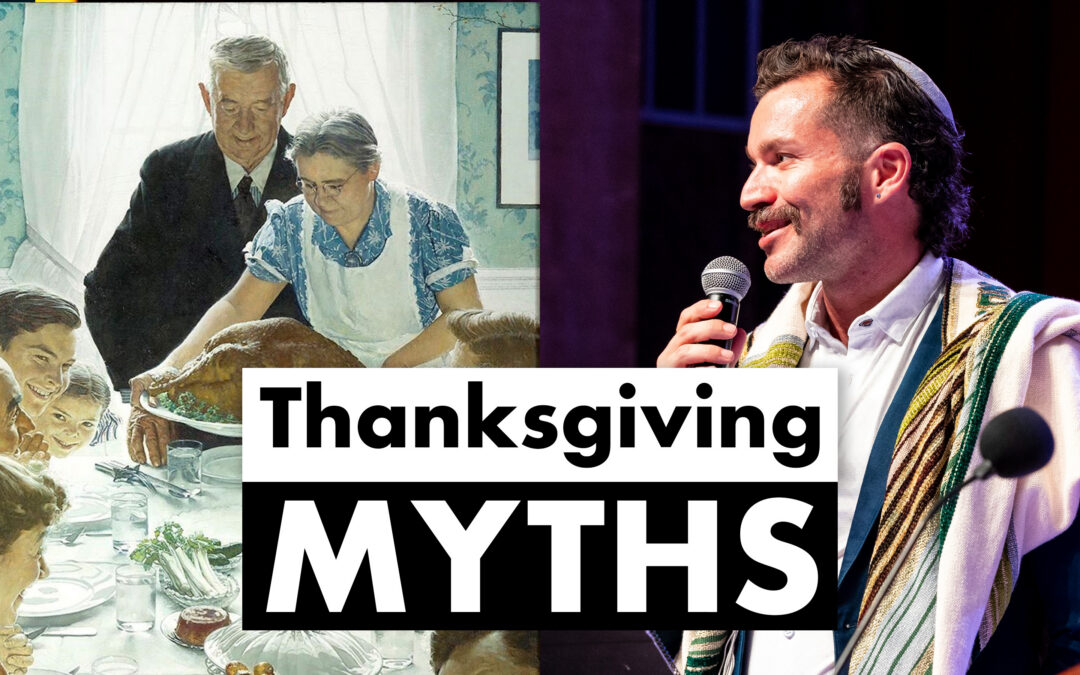
Like every holiday, Thanksgiving is expressed through stories. There is the originating myth of Pilgrims and Indians sitting around a common table to share food (and the real, more troubling, history that exists in the background). There is the contemporary myth, about the American family celebrating this day — grandparents, parents, and children happily gathered for a meal like a Normal Rockwell painting. There are the stories we tell about our own lives, which mimic that ideal image. And then there are the harder, more painful stories we also tell, more often than not through what is not said — like when I’m talking with someone about their plans for Thanksgiving and they say that they’re not going home, or that their family has decided not to get together this year, or when everyone does get together but a person that appeared in photos and social media posts last year is conspicuously absent from those same photos and social media posts this year.
The foundational myths of Thanksgiving are hopeful (the title of the Normal Rockwell painting in question is Freedom From Want). But during the holiday season, inundated with pictures of familial bliss, many of us become acutely aware of the gaps between our own lives and the image of that happy family. And it may be that our families are, in fact, happy. But even for the rare home that has not been reframed by disagreement, disownment, or divorce, death will eventually remove people from the picture — if not has already. In her book Navigating Loss, Heather Stang writes that we are grieving more than the person (or the people) who are no longer there, but the relationship you had, the relationship you wanted, the traditions that disappeared, and the hope that things would eventually be different. Even if the loss was anticipated, even if it happened at the expected time or for good reasons, it can be a heartbreak of multiple fractures.
As a rabbi, but also as a friend and a partner, I have had the privilege (to borrow an image from Brene Brown) of sitting in the pit with people as they try to find their bearings in the chasm between what they so desperately wanted and what actually is. And what consistently amazes me is how each of these people, in the midst of turmoil and despair, has found the ability to get up, brush their teeth, get dressed, and take another step forward — even if they don’t know where this new path leads. A condition of being alive is uncertainty, but a fact of the human condition is an incredible resilience.
We open the Torah this week to the story of Jacob, putting one foot in front of the other as he journeys from a place he thought he knew to a place he never imagined. It is not the story that Jacob thought he would tell. His family has fallen apart. Encouraged by his mother, he deceived his aging father and stole the birthright from his first-born brother. His life as the second son is over. Jacob has lost his home, he has lost his relationships, and he has lost the predictability of life as he knew it. And now he is stumbling through the wilderness toward a destination and a destiny that he neither knows nor understands. It would be easy and understandable to give up. Yet somehow, bearing the fragments of his heart across the broken landscape, he makes the trek from Beersheva to Haran. For perspective, that’s about 500 miles.
Somewhere along the way (and where we find him in this parashah), Jacob stops to rest. He is scared. He is uncertain. He is exhausted. Jacob is so heartworn and weary that he finds a rock to lay his head on. He falls asleep — and once asleep, he dreams.
Jacob dreams of a ladder, stretching between heaven and earth. And on this ladder, divine messengers ascending and descending. And suddenly he finds himself in the presence of God, who says:
“Ani Adonai elohei Avraham avicha v’Yiztchak, I am Adonai the God of your forefathers Abraham and Isaac. The land you are standing on will be given to you and your offspring. Your descendants will be like the dust of the earth, spreading in every direction — west and east, north and south. Other people will bless themselves by your name. Remember that I am with you. I will protect you wherever you go and bring you back to this land. Lo e’ezavkha, I will not leave you.”
And then Jacob wakes up. He looks around at the barren wilderness, what was formerly the landscape of his uncertainty and despair, and exclaims: “Achein yesh Adonai ba’makom ha’zeh v’ani lo yadati, surely God is in this place, and I didn’t know it!”
The medieval commentator, Rabbi Shmuel ben Meir (aka the Rashbam) writes that every time the word achein appears in the Torah, it means something like “Whoa, this is not at all what I expected.”
Deep in the pit of his grief, mourning the loss of the life he knew and the life that he had anticipated, Jacob finds a future that he could have never imagined. In some ways, it is better than what he had expected as the soft-spoken second son of Isaac and Rachel. And we know that in other ways, God’s promise came with burdens that were far greater than those he might have borne given the opportunity to stay home and live an otherwise unremarkable life in the shadow of his brother Esau. But with that course no longer tenable, it is a path forward. And the only way that he found this path forward was by refusing to stand still, taking step after stumbling step even when he didn’t know where it would lead him.
The story of our lives rarely mirrors the myths that we were raised on. And that can be really hard. Who doesn’t want to sit at Normal Rockwell’s table, one happy family with full bellies and fuller hearts? The absent bodies and empty chairs in our dining rooms (if we even have a dining room to sit in) are spaces easily occupied by grief and despair. But in that dark place is where I find God in the equation. God is in the resilience of the human heart. We still have to make a choice. But resilience is the foundation we step on when we choose to find our way forward, even though we don’t know (and perhaps have good reason to be afraid of or worry about) what lies ahead.
And here is my amazement — at the person who allows themselves to fall in love after heartbreak, or the person who builds trust following betrayal, or the person who invites others in after they’ve been pushed away. These are the heroes of a new story — not necessarily the story we wanted, nor the story we expected to tell, but the story nonetheless. All of you, here in this room, by the very fact that you are human beings finding your way forward in a world that is not always as it should be, have made this choice — drawing upon your resilience, even when it’s hard and even when it’s unfair, to take that next step. It may not have seemed like much at the time, but here we are, and that is something to be thankful for.
A few days ago, my friends and I came together for an impromptu Friendsgiving. I had planned to have a few people over, and one of them wanted to make pumpkin pie, and another friend I spoke to earlier that day was already planning a butternut squash mac and cheese for dinner (yes, it was delicious) — and so why not bring in the holiday a little early. None of us are going home for Thanksgiving. Each of us could tell a version of the same story, so common among queer folks — parents who disowned us, or relatives that barely tolerated us, or families that demanded we constrain and contort parts of ourselves to maintain peace at the dinner table. But there we were, telling another story. Not the one we expected, and certainly nothing like what Norman Rockwell envisioned (or maybe he envisioned it, but never painted it). This one was louder, and gayer, and probably a bit more crass — but it is a good story, one each of us came to through choices big and small, but mostly the choice to not give up until, step by step, we arrived at that moment.
There is a blessing we say, at moments like that, one that you probably know: sheheheyanu, v’kiyemany, v’higianu laz’man ha’zeh, blessed is the one who has sustained us, who has given us strength, and enabled us to reach this time. The blessing is just as much about thanking God as it is about thanking ourselves. While God may have given us the ability to choose, the choice was ours to make. How sacred. How holy. How worthy of blessing.
Maybe this holiday season will look like the story you expected. Perhaps it won’t. But my hope, for all of you, is that no matter what it brings you are able to remember your resilience and your strength — and that you are able to choose a different story, if you want to or need to. And my prayer this season is for that story, the story you choose, to end in blessing.
Beautifully written.