
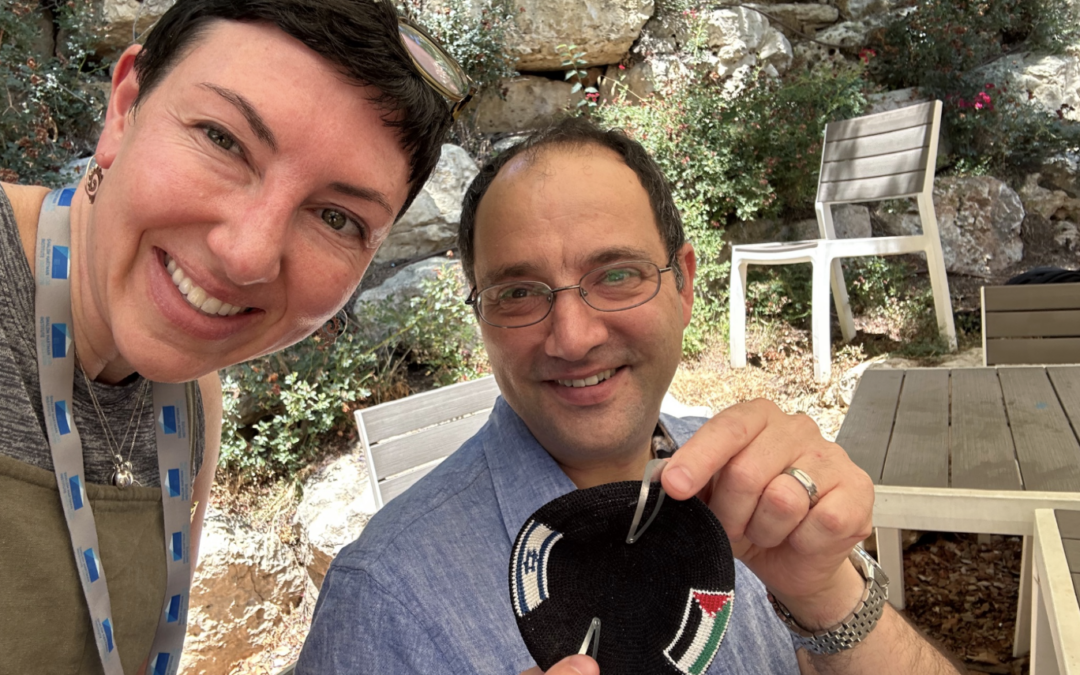
The picture above is me with Israeli educator, Alex Sinclair. For more than two decades, he’s worn a kippah that bears both an Israeli and Palestinian flag. With it, he’s saying three things: I’m a religious Jew, I care about Jewish identity and sovereignty, and I care about Palestinian identity and sovereignty. He refuses to see Israel and Palestine as opposites — the people of each identity are now woven together into the same story (whether many people of each group like it or not), and the future of each people depends on the other.
In an age where the humanity of certain people is treated as conditional (and boy, do Jews know what that feels like), to be on one side of a conflict and assert that the peoples on both sides of it are fully human — despite leadership that speaks and acts otherwise, and extremists whose actions and words mock that assertion — is nothing short of radical. It is an important and necessary statement of moral imagination and moral commitment.
A few months ago in his town of Modi’in, Israel, Alex was detained by the police and thrown in jail for a day for the provocation of wearing this kippah. When they released him, they gave him back the kippah — with the Palestinian flag cut out, as if to say, “your imagination borders on criminal.” After he was released, he went on to talk about the incident on international television, to write about it, and, of course, to have a few new Israeli/Palestinian flag kippot made.
These past three weeks I have spent in Israel have been challenging and meaningful, as always. The best part is always meeting people who, like Alex, defy the stereotypes and work each day in their own way to create a political, emotional, and even spiritual permission structure to imagine a peaceful future in this land between Jews and Palestinians. I’ll have more to share when I’m back.
In the meantime, I’ll be spending Tisha b’Av in Germany, where I’ll be visiting the town in which my grandfather, Julius Heydemann, was born and raised. I’ll be traveling with Ima Drolshagen, the German exchange student with whom I was paired in 1997 when I was a sophomore in high school, and with whom I’ve stayed in touch all these years. The last time I saw her, also en route to Israel, we talked about what our grandparents did during the Second World War. Mine fled Germany. Hers drove trains.
And yet, she has become the fiercest ally and friend I’ve ever had. She’ll be accompanying me to visit the house my Grandpa Julius was born in, and she’ll be fasting with me tomorrow on Tisha b’av. Germany was the origin site of an inestimable amount of destruction to the Jewish people on every level… and yet, no country has done more by way of reparations for oppression and genocide than Germany has done since. It is a model for how a country can behave when it stands guilty of the mass destruction of a culture. Within a few years of the end of World War Two, Germany’s government officially recognized the incalculable harm it caused to the Jews of Europe, and committed to make teshuvah. This commitment to never again repeat the mistakes of the past, combined with the hundreds of billions of dollars in reparations to Jewish people and causes, have created the conditions where Jews are returning to build lives in Germany when other places in the world feel less welcoming. It has also created a present in which a relationship like mine and Ima’s is possible.
Jewish tradition states that the messiah will be born on Tisha b’Av. In other words, even in the midst of the heart of darkness, the seeds of repair, renewal, and rebirth can be sown. “Those who sow in tears shall reap in joy,” says the Psalmist. Moral imagination is powerful and necessary. It is the bridge between the losses of the past and the promise of a better tomorrow.
I pray that this Tisha b’Av, you’ll take the opportunity not only to mourn the losses of life, of safety, and of innocence, we sit with as Jews, wherever we sit in the world, but also take the opportunity to naively imagine what repair and rebirth would look like, smell like, taste like, and feel like, so that we can work toward a future where all of us take the humanity of each person on this earth to be a sacred gift, to be protected and cherished.
Sending you blessings for a meaningful Tisha b’Av—
R’ Lizzi
It is a challenge to acknowledge, to center, the humanity of “the other” — especially when some members of that other group have perpetrated horrible acts on people in “my” group. But that is our challenge: to rise above anger, hatred and desire for revenge, and find a halting way forward toward peace and reconciliation. Tough sledding!