
You can listen to this drash on Contact Chai Podcast or watch it now on our YouTube channel.
****
The rabbis tell a ghost story:
It was almost Rosh Ha’Shanah, at the end of a difficult year. As the sun began to set, a pious man rushed home for the holiday. He encountered a beggar and, although he did not have much, he gave the person some money. But when he came home, his wife berated him for giving away what little they had left. She kicked him out of the house, and so he came to pass the night in the graveyard.
Just as he was about to fall asleep, he heard two spirits calling to one another. One spirit said: Let us go out and peer behind the heavenly veil to see what will happen in the year to come. The other spirit said: You go. My family was poor and buried me in a mat of reeds, so I am too embarrassed to leave my grave. So she went and returned. The other spirit asked: My friend, what did you discover behind the heavenly veil? She replied: I found out that anyone who sows during the first rainy season of the year, hail will fall and strike their crops. Hearing this, the pious man went and sowed his seeds during the second rainy season. Everyone else’s crops were struck by hail, but his crops were spared.
The next year, the pious man returned to the graveyard. Again, he heard the two spirits calling to one another. One spirit said: Let us go out and peer behind the heavenly veil to see what will happen in the year to come. The other spirit said: I have already told you, I am too embarrassed to leave my grave. You go. So she went and returned. The other spirit asked: My friend, what did you discover behind the heavenly veil? She replied: I found out that anyone who sows during the second rainy season, blight will come and strike their crops. Hearing this, the pious man went and sowed his seeds during the first rainy season. Everyone else’s crops were blighted, but his crops were spared.
Suspicious, his wife asked the pious man how he had become so lucky. And so he told her everything. A short time later, she got into a fight with the mother of the girl buried in the graveyard. In anger, the pious man’s wife said scornfully: Your daughter is buried in a mat of reeds.
The following year, the pious man returned to the graveyard. Once again, he heard the two spirits calling to one another. One spirit said: Let us go out and peer behind the heavenly veil to see what will happen in the year to come. But the other spirit said: My friend, leave me alone, as the words that we exchanged between us have been heard among the living.
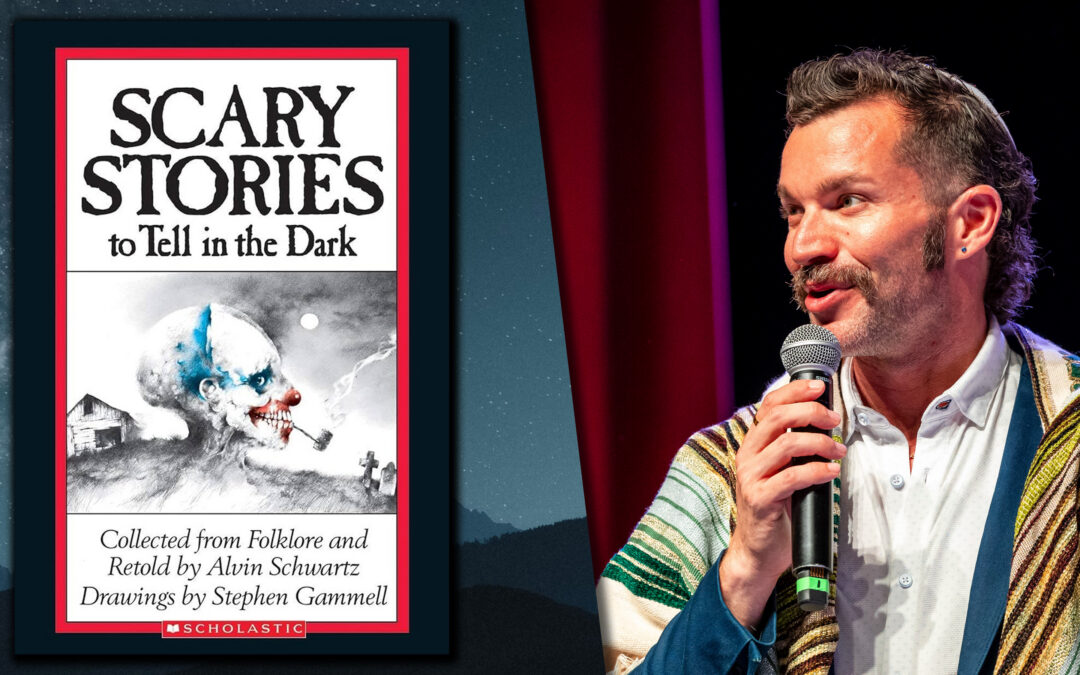
My family loves to tell ghost stories. On camping trips, as we gathered around the crackling fire, my stepmother would bring out a worn copy of Scary Stories to Tell in the Dark — or perhaps, More Scary Stories to Tell in the Dark. She would read one story, then pass the book to my dad who would read the next, as the flames slowly died and the dark inched closer to our campsite. I was terrified. Even the covers of those books scared me (I would make sure they were safely locked in the car when we finished). My temperament was not built for campfire stories, or scary movies, or macabre decorations, or most of the things that people love about spooky season — that is, the season we find ourselves in right now. As a child, I started a ritual of staying up until midnight on Halloween. When the clock flipped from 12:00 to 12:01, I knew that I was safe and could go to sleep. Three decades later, I still stay up until midnight.
A love of ghosts and their monstrous companions is a phenomenon called recreational fear. What separates recreational fear from what actually terrifies us is that we know its source and we understand its limits. Haiyang Yang, a behavioral scientist, explains that it is contained by a “protective frame” defined by safety, distance, and control. We watch a scary movie in the safety of our homes, knowing that its horrors are contained within the television screen, able to turn it off at any time. Every person has a different barometer of what feels safe, distant, or controllable. I can handle a scary movie on a small screen when the sun is out. But a movie theater? It’s too big, too close, too much.
The horrors of the world are horrifying precisely because they confront us with how little we understand or have agency over. And so we develop rituals that distract us from this uncomfortable truth. Amulets and talismans. Incantations. Magic, or even magical thinking. All of these help us feel like we are the master of our own fate, by naming the unknown or uncontrollable and tricking us into thinking that this one thing will fix it.
Believe it or not, a substantial chunk of the Talmud is concerned with demons. The rabbis blame demons for quite a few maladies: knees that ache for no reason, clothes that wear out even though we just purchased them, feet that hurt even though we’ve been sitting all day. The rabbis are also worried that they may be the source of more serious problems, like seizures. But by making the unknown known, we can figure out a way to prevent their ill effects.
A particularly troublesome demon (and you are going to think I’m joking, but I’m not) is the one that haunts our bathrooms. The rabbis suggest a number of ways to protect yourself. Rabbi Tanhum bar Hanilai says that modesty will spare you: be quick, be quiet, and be clean. Abaye’s mother gave him a lamb, who would accompany him to the bathroom (I am certain this is why our pets insist on joining us when we’re sitting on the toilet). Rava had his wife stand outside the bathroom and rattle a nut in a copper vessel. When that stopped working, he had a window built above the toilet so she could put her hand through and place it on his head.
This all feels laughable, and from our vantage point perhaps it is, but the rabbis are driven by the same anxiety that pushes people to become workaholics, or obsess about their health, or yell at strangers on the internet (or their partner, or their kids) — trying to find some semblance of control in a world that increasingly feels out of control. This is a kind of magical thinking, the belief that we can create a new reality through force of will. It’s true, sometimes these things are well-meaning responses to challenging times; it’s not wrong to care about what you do, or how you’re doing, or how the people in your life are doing — in moderation. Because we also know that sometimes our attempt to hold on to something too tightly can break the very thing we are trying to protect.
There are a lot of reasons to be worried right now. Spooky season is also election season, for us here in America and for the other half of the world’s Jews living in Israel. There is growing uncertainty about what the future holds — and if the political campaign ads are to be believed, we are teetering on the edge of horror (as Israelis went to the polls on Tuesday, Netanyahu sent out an AI-generated image of a nuclear bomb falling on Tel Aviv; also this week, and closer to home, senatorial candidate Abdul El-Sayed was the target of claims that he will impose sharia law on Michiganders — dictating what women wear, requiring them to have a guardian, and prohibiting them from filing for divorce). Of course, every politician sells themselves as a sort of talisman — as if their bravado, like the nut rattling in its copper vessel, will scare the demons away. It’s tempting to believe them. Wouldn’t it be nice if the right candidate would solve everything? But to believe their promise that the complex problems of the world can be fixed by one person or policy is, in and of itself, a kind of magical thinking.
Understanding that navigating life’s challenges is more complicated than having the right amulet or incantation, our tradition eventually turns from ghosts and demons and the rituals that might protect us from them. Don’t get me wrong, these stories are fun (my boyfriend has doggedly been increasing my tolerance for scary movies, just in time for Halloween). And amulets, incantations, and other forms of magic can be meaningful and culturally significant. But they are not how we find our way forward when the path is unclear.
When we open the Torah this Shabbat, we read about Hagar and her child Ishmael being cast from their home into the wilderness. She doesn’t know where she is or where she is supposed to go — and soon, they run out of water. Feeling like there is nothing that she can do, Hagar places Ishmael under a bush, walks away from him, and weeps. She is scared, for herself and her child, forced to acknowledge the limits of her own agency. Their waterskin is empty; she can’t make it full again. An angel appears and asks, “What is troubling you?” Hagar looks up, toward the voice, and sees a well of water.
The thing is, nothing changed. The well was there all along. Yet by focusing on the empty waterskin, allowing herself to become overwhelmed by what she couldn’t control, Hagar wasn’t able to see other solutions that existed right in front of her. Unlike the pious man eavesdropping on ghosts, trying to get a hint of what will happen in the future so that he can control its outcome, the angel shows Hagar what is: both what she can’t control — the parched wilderness, the empty waterskin, the crying child — but also where she can exercise her agency, drawing water from a well that, although not a guarantee that everything is going to be okay, is enough to get them through right now.
I’m a generally anxious person. It’s a relatively new part of my personality, so there’s been a learning curve for figuring out how to function while worried. It comes from a place of care, wanting the best for the world, the people I love, and myself. But sometimes these concerns can become overwhelming, as I worry about all the possibilities that tomorrow might bring. One of my most valuable and effective coping mechanisms is something I call “what is real and what is true” — to name what is real around me and what I know to be true inside me. Going through this list helps me clear my head, so I can find solutions that are harder to see from a place of panic or fear. There is a lot we don’t know about tomorrow. But I do know that, in this moment, we are here, safe within these four walls, and that we have each other. I know that we have inherited a tradition that gives us powerful tools for overcoming seemingly impossible challenges. I know that we are compassionate, we are creative, and we are capable.
On our reading from the Torah, Rabbi Eliezer Shemtov teaches, “God does not do for us what we ourselves can and must do.” Magical thinking tries to force a miracle. Our tradition calls us to look at the world with clear eyes. This means acknowledging that yes, there is a lot that we can’t control: pain we cannot mend, losses we cannot repair, words and actions we can’t take back — and that’s hard, and that’s scary. But like Hagar, we are invited to look around and see what is there, what well we can draw from even if it’s just enough to take the next step forward. But in an unbalanced world sometimes finding our footing, in and of itself, is enough.