
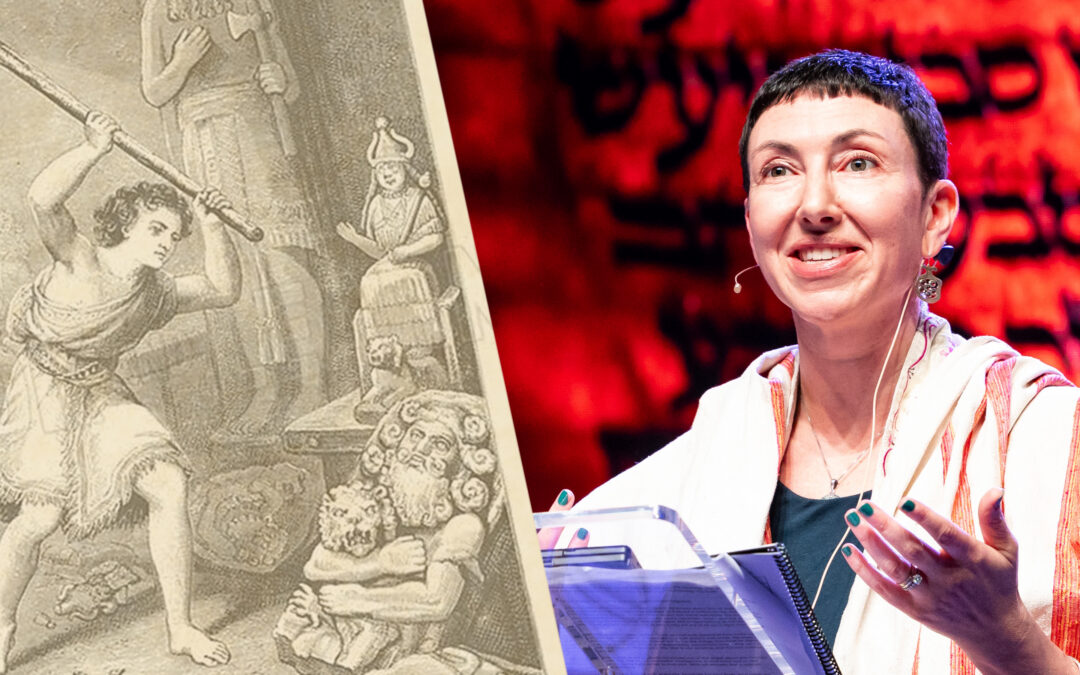
This sermon was delivered at our service on October 24th, 2026. You can listen to this drash on Contact Chai Podcast or watch it on Mishkan’s YouTube channel.
****
The Torah reading over the past two weeks — the first two parshiyot in the Torah — really lay the groundwork for where we read from today. I really encourage you to go back and listen to Rabbi Steven’s sermon from Parshat Bereshit/Genesis, and Rabbi Julie’s sermon from last week from Parshat Noah — both really showcase these opening sections, not just as a bunch of stories, but as the foundational and unique Jewish framework for understanding the world we live in, distinct from other religious and cultural texts that were being written at the same time.
In those opening chapters we get introduced to our main character, God, who contrary to popular opinion, does not create our universe from nothing, rather, creates out of the existing raw materials, including mayim (water), tehom (a boundless depth), and tohu va’vohu — meaning something like chaos, but because it rhymes, it’s poetic chaos. Tohu va’vohu! Not just “chaos and void,” as it’s usually translated, but something more like chaos/shmaos. The Torah asserts that this world in all its shimmering beauty came into being because God not only wanted to order the chaos shmaos of those raw materials into an intricate, miraculous biosphere, but that God wanted a partner in stewarding it: the incredible final crown of creation, the human being.
But humanity does not fail to disappoint, early and often. All those first humans needed to do was not eat from one tree and they could have stayed in that beautiful garden of plenty… but they got curious, poked their noses where they knew they shouldn’t, and paid the price for it, and as a consequence were exiled from the garden. Humanity would live forevermore with a memory, a felt sense, of the possibility of having it all, and a desperate, unquenchible desire to get back to that place of wholeness, often manifesting in behaviors we do at our own peril born of that deep insecurity, trying to recover that original sense of perfection.
Parashat Noah opens in a world filled with such perilousness — violence, corruption, selfishness, a sense of scarcity. God’s heart is utterly broken, and God sends a flood to wash it all away and start again fresh. But when humanity reconstitutes itself, it all comes right back. God accepts these flawed humans for who we are and promises not to destroy the world again on our account, the implication of course being, God will not destroy us, but we, humanity, are perfectly capable of destroying ourselves.
It’s hard to believe that, in an age before the harnessing of atomic energy, before the ravages of climate change and the threats of artificial intelligence, both environmental and technological, our ancestors were aware that humanity would have a kind of godlike power. While 3,000 years ago that power was much more localized, the feeling of living in a world that is precariously teetering on destruction was a familiar feeling, and it is the feeling our text is speaking out of.
Enter Avram. We aren’t told a single thing about him. And yet this week’s parasha begins with the famous lines: “God said to Avram, Lech lecha, go forth from your native land and from your father’s house to the land that I will show you. I will make of you a great nation, and I will bless you; I will make your name great, and you shall be a blessing. I will bless those who bless you and curse the one who curses you; and all the families of the earth shall bless themselves by you.”
The absence of any context about Avram’s character gives rise to an entire literature of stories trying to explain what it was about Avram that distinguished him among the humans on planet Earth at the time, to be chosen as a partner by God for this mission of blessing. Because you’re not going to read these in the Torah, I want to share a few of these with you to see what we can learn about the kind of person it seems that God wants to partner with to heal and perfect this world, at least according to Jewish tradition.
Avram is referred to as haIvri, simply, the Hebrew, but ayin vet resh as a root, means to cross over, to be on the other side of something. Avram haIvri, is, Rav Judah says, refers to “the one who, when the whole world is on one side, he is on the other.”
There’s more midrash to give us a sense of what that looked like. In one story, Abraham as a teenager is working in his father’s store. His father sold idols, and so Abraham got to know the business intimately. A guy comes in, and Avram says, “What kind of God do you wish to buy?” The man says, “I’m a mighty man. Give me a God as mighty as I am.” Avram took the idol that was on a higher shelf than the others and said, “Pay the money and take this one.” The man asked, “Is this God as mighty as I am?” Avram replied, “You idiot. Don’t you know how the gods work? The one who sits above all others on a higher shelf is obviously the mightiest of all.”
As the man is leaving with his idol, Avram asks him, “How old are you?” The man answers, “Seventy.” Avram says, “It’s embarrassing that a 70 year old is prostrating himself before this thing that we made today.” In that moment, the man flings the idol back into Avram’s basket, demands his money back, and goes on his way.
Next comes a widow, who says to Avram, “I am poor and wretched. Give me a god as poor as I am.” At once, Avram takes an idol from a lower shelf and said to her, “To suit your poverty, take this god who is humble, which we know because he is on the lowest shelf below all the others. But he won’t go anywhere till you pay me the money.” So she pays him, and she’s about to leave. Then he asks her, “How old are you?” and she replies, “Very old.” Then Avram says, “To think that one so mature would prostrate herself before a god who is only a day old.” At that, she throws the idol back into his basket, gets her money back, and goes on her way.
So Avram takes all the gods and brings them back to his father. Terach’s other sons say to their father, “Your son Avram clearly does not know how to sell idols.”
But we can see from the midrash that he absolutely knows how to sell idols. He’s quite good at it, because he understands the human yearning the business is based on. He sees all the vulnerability and insecurity that leads people into the store to place their faith in something made of stone or wood that cannot heal or save but offers a momentary feeling of hopefulness, of a salve, a dopamine hit. A little taste, for even just a moment, of that wholeness of the Garden of Eden. He knows he could exploit that, yet he does not. In every case, his hope and prayer for each person is that they rise to a level of self-awareness and connection with something more powerful, something more real than he, or his father, or these idols can promise.
Because he is a chutzpadik teenager, he has not quite figured out how to share his newfound truth in a way that doesn’t drive people out of the store, but he has realized that he can make them think. That is a critical first step to being God’s partner. You can imagine the creator of the universe, so disappointed with humanity’s conformity, the contagiousness of insecurity, jealousy, and the awful things that it makes people do to themselves and to one another. God thinks to herself: “I’m going to keep an eye on this one.”
Since Avram is not a successful idol salesman, his father puts him in charge of being a priest to the idols, which means feeding them.
One day a woman comes in with a bowl of fine flour and says, “Feed this to the gods, on my behalf.” She leaves at which point Avram seizes a stick and smashes all the idols, and then places the stick in the hand of the biggest one.
When his father comes in, he says, “Who did this to the gods?” and Avram answered, “Would I hide anything from you, dad? A woman came in with a bowl of flour and said, ‘Here, offer it up to them.’ When I offered it up, this god said, ‘I will eat it first,’ and then that god said, ‘No, I will eat it first.’ Then the biggest of them smashed all the others.” His father replies, “Are you making fun of me? You know they can’t do anything.” Avram answered, “You say they can’t do anything? Let your ears hear what your mouth is saying!”
Avram is an iconoclast, an idol smasher in the original Greek sense of the word, and not just for the sake of being provocative, but for the sake of helping lift the scales from the eyes of his fellow humans, showing them a better way than to placate their insecurities and their fears with more stuff — false advertising about getting back to the garden of Eden. He indeed leaves his father’s house — and his father’s line of work — and builds a new religious community, based not on the worship of material, but on the worship of something far more subtle, more powerful and more universal, and more socially connecting than any item of wood or stone could ever be. He speaks from a place of having done his own research, having gotten close to the very thing he rails against and so can now say with certainty, “This doesn’t work. Let’s try something different.”
Iconoclastic, brazen, chutzpadik. These words are the surprising dating profile or the job description of the partner God was looking for for the job of healing a world that feels precariously balanced between existence and destruction. And whereas some of the traditions that trace their lineage back to Abraham, have tamed those instincts to smash idols, challenge authority and argue with convention, the Jewish tradition has amplified and honed them, making holidays out of the stories of the oppressed overthrowing of empires, of everyday men and women not bowing to tyrants, of children thwarting the might of armies.
Rabbi Jonathan Sacks describes being Jewish, being a child of Abraham, as having:
“…The courage to be different, to challenge the idols of the age, whatever the idols and whichever the age. In an era of polytheism, that meant seeing the universe as the product of a single creative will… In an era of slavery, it meant refusing to accept the status quo in the name of God, instead challenging it in the name of God. When power was worshipped, it meant constructing a society that cared for the powerless: the widow, orphan, and stranger. During centuries in which the mass of humankind was sunk in ignorance, it meant honouring education as the key to human dignity and creating schools to provide universal literacy. When war was the test of humanity, it meant striving for peace. In ages of radical individualism like today, it means knowing that we are not what we own but what we share; not what we buy but what we give; that there is something higher than appetite and desire — namely the call that comes to us, as it came to Abraham, from outside ourselves, summoning us to make a contribution to the world.”
What is it that you think is a prevailing truth that requires brave, discerning souls to unmask the falsehood of, and find a better way?
I had a few thoughts… in no particular order. I think many people associate happiness with wealth or acquisition. This is not exactly a new realization, but there are new and insidious ways that the Terah’s of the world continue to sell people the idea that their lives will be better if they just get this one thing. A child of Abraham knows that while any one of those things may in fact be delightful (I have gotten some very handy fidget toys off targeted Facebook ads, don’t get me wrong)… yet we know that there is something deeper and higher that is the source of our happiness and fulfillment. The idea that there’s a thing that will make us happy once and for all, returning us to the perfection of the Garden of Eden — whether it’s an item or a relationship or a child or anything external — is an illusion.
Another prevailing convention that a Child of Abraham could bust… Social media and sound bites. Right now, we are going into the midterm season, and there is a lot of, frankly, slander going around about candidates, and nonsense being shared masquerading as news or truthful information. People say reasonable things that take a paragraph or two and then get caught in sound bites that reduce them to caricatures of whatever the other side wants to paint them as. We owe it to our democracy to think more deeply than in the 30 second ads and redacted sound bites, to throw away the mounds of paper mailers we’re getting scaring us into voting a certain way without actually understanding anything about the issues, policies, and ideas at play. Most people are, at this point, receiving their news on sites like TikTok. A descendant of Abraham looks at the bigger picture, watches the whole clip, talks to a bunch of different kinds of people, reads a bunch of voter guides, and understands that the caricatures being painted are very often a lie meant to serve somebody else’s agenda. I imagine that a lot of you already do this, and it can feel overwhelming sometimes to put that kind of energy and research in, especially when people around you seem so sure. But this feeling is part of what it is to be a child of Abraham.
The result of this may be that we need to imitate Avram in another important way: standing in a different place than our families or our communities, on issues we all care a lot about, but express that care differently. Avram’s family was not happy about his hot take on the family business. But he wasn’t doing and saying what he was doing and saying to be popular. He stood alone, on one side, while the world stood on the other. And yet, eventually Avram becomes Avraham, the Father of Many Nations. His willingness to stand alone is precisely what makes belonging to something bigger than himself possible.
In Braving the Wilderness, Brene Brown writes:
“Belonging so fully to yourself that you’re willing to stand alone, is a wilderness — an untamed, unpredictable place of solitude and searching. But it turns out to be the place of true belonging, and it’s the bravest and most sacred place you will ever stand… It’s about breaking down the walls, abandoning our ideological bunkers, and living from our wild heart rather than our weary hurt.”
Living from our wild heart rather than our weary hurt. God says“Go forth, away from your land, from your birthplace, from your father’s house, to a land that I will show you.” The land that God will show Avram is going to come with pain, struggle, and sacrifice. It’s going to come with inspiration and transcendence. Avram will be fully present for all of it.
Avram is not promised comfort or happiness on this journey, and sadly, neither are we. But we are invited to be partners in the work of creation — through our keen observation of the world, through our willingness to tell the truth, and to grow more wise and diplomatic as we do. Sometimes we’ll need to stand alone — leaving our proverbial parents’ house and our birthplace — and know that our willingness to endure unpopularity is also our staying power: sometimes standing alone carves out the space for those afraid to take that step themselves, and generation after generation, the tribe grows, as do all the blessings that come along with it.
May we all merit to be that partner, and to be that blessing, in all its challenge and reward, bittersweetness and blessing. Shabbat shalom.