
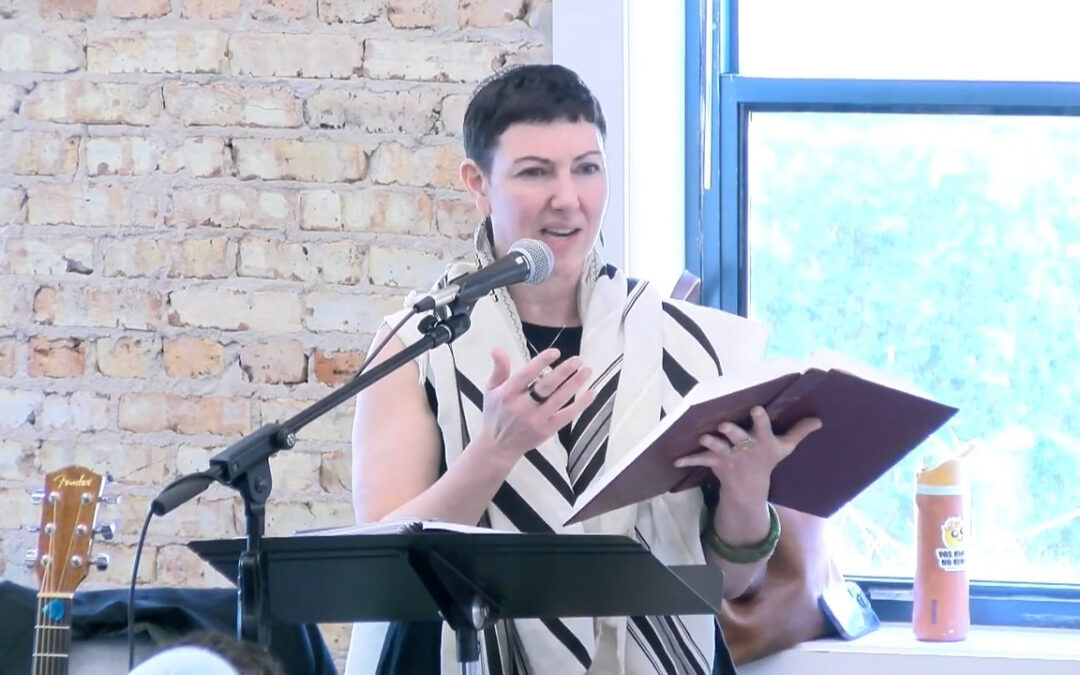
This sermon was delivered at our service on May 2nd, 2026. You can listen to this drash on Contact Chai Podcast or watch it on our YouTube channel.
****
I loved hearing Gideon’s take on this week’s parashah. I love how he drew out the positive stuff, because truthfully in this parashah, and in the whole the book of Leviticus, there is a lot of stuff that is really, to say it diplomatically… ancient. And to be a little less diplomatic, and more straightforward, some of the stuff in this book of the Torah is really hard to read, at least to the modern reader. It’s one of the reasons we’re so grateful for 2,000 years of interpretation and commentary, to help us make meaning of words and stories that we might otherwise find really outdated and even problematic.
That’s the preface to this toughy of a story we get at the very very end of the parsha. I’m going to read to you straight out of the book — just the pshat, the text itself, before we do anything else with it.
A man went out into the camp. His mother was an Israelite woman, from the tribe of Dan. We even learn her name, which is unusual: Shlomit, daughter of Divri. His father was Egyptian. This man gets into a fight with another Israelite, and then he does something that violates one of the 10 commandments and that the community regards as catastrophic: he curses the ineffable Name of God. Blasphemy. The people who hear it bring him to Moshe. Moses doesn’t know what to do with him, so they bring the case to God to weigh in. And God says: take him outside the camp, and have everyone who heard it lay their hands on his head. And then have the whole community stone him. This shall be the punishment for anyone, citizen or stranger, who blasphemes God. (Leviticus 24:10-15)
Everyone get the basic course of events? Guy goes out into the Israelite camp, breaks the rules, gets punished for it. Now, I’m going to read the story again, and I want you to listen for clues that you think might be important for understanding what’s happening here beneath the surface, on the level not of pshat, what we can see, but drash: what we can’t see, but is necessary to explain what’s really happening. Every prop on the stage, every word in the Torah, has a purpose, and often the purpose is to get us to look more closely at what’s going on here to find the lesson, the drash, especially in the sections we find morally challenging. So listen for those clues.
First, this man has no name. In a Torah that is meticulous about genealogy, that goes to great lengths to tell us who begat whom, this man is identified only by his parents. He is “the son of an Israelite woman whose father was an Egyptian.” That double identification — one foot in each world — is doing something. He is a person caught between two identities, belonging fully to neither.
His mom has a name: Shlomit bat Dibri from the Tribe of Dan. Why do we need to know that?
The Torah tells us he “went out” — yatsah ish. That’s how the story begins. He went out. Out from where? Into what? The text doesn’t say, and that gap is an invitation.
Look at the order of events. He went out. He fought. He cursed. That’s a sequence, not just a list. Something set this in motion.
Now here’s where I need you to stay with me, because I think there’s something so much more complex and heartbreaking happening in this text than the simple story of a bad guy doing a bad thing and him getting the consequences he deserves (even if we now think getting stoned to death is a little harsh for the crime of blasphemy).
The rabbis of the midrash scratch beneath the surface (that’s what they do!). They see the Torah’s choice of words as invitations to curiosity, and here they ask a question that sounds almost too simple. The verse says V’yetse ben Ish… — “and a man went out.” Minayin yatsah — Went out from where?
It’s a small question, but I love it, because it’s the kind of question that reminds you that the headline is only a moment, a snapshot, in the story, and if you widen the lens of the camera, or turn the clock back even five minutes, let alone five or ten years, sin doesn’t happen in a vacuum. People don’t just snap. There’s always a minayin, from where, a story behind the headline, context, a history, a wound that nobody bothered to ask about.
The midrash offers a few answers to that question, I want to share one of them with you because it helps us understand this strange and troubling story not only as an example of the Torah being ancient and punitive, but actually revealing to us, as it so often does, a very human tendency that we ourselves need to take care not to imitate.
The biblical scholar Rashi, citing ancient midrash, tells us, Yatsah m’beit din shel Moshe– He went out, he from Moses’ Court. Interesting. Why was he there?
Here’s the story:
His mother, Shlomit, is Israelite, from the tribe of Dan. His father is Egyptian, and as far as we know, not one of the cool Egyptians who joined the Israelites in their liberation march out of Egypt. Since this guy is referred to as an ish (a man, not a child) we can assume that he actually spent some of his life in Egypt, but now is having to make his way exclusively among his mother’s side of the family. So he comes to the camp of Dan — his mother’s tribe — to pitch his tent there. To have a home, to belong somewhere. And the people of Dan say: “You can’t be here. Our rules said that identity follows the father’s lineage. You’re the son of an Egyptian man,” they say, “You’re not part of our tribe. You don’t have a place here.” But according to this rule, he wouldn’t have a place anywhere. So, the midrash says, he took his case to court, going before Moshe himself. And he loses. And then, only then, he went out, fought with someone and in his anger, curses the name of God.
Now it’s a much juicer story, right?
I keep sitting with that sequence. He was already part of a marginalized demographic, in that he came from a mixed-heritage home on “the wrong side”. He tried to fit in, to join the tribe of one of his parents, and have a home and a place to belong. But they rejected him, so he took it up a level and looked to the system to provide justice. And the system told him: there’s no place for you. No place for you, and no justice to be found for your unfortunate situation. Case closed.
What do we think happens to people with no sense of place, or home, and no sense of future, and no sense of community? No wonder he curses God. It’s actually kind of shocking that that’s all he does, as serious of a crime as blasphemy was back then.
But then the midrash goes on, even further back, further out of the frame, to tell us who this guy’s father actually was. And it’s even more painful than we realized.
He wasn’t just Egyptian, he was a taskmaster. And this particular taskmaster — according to the midrash — did not have a loving, consensual relationship with Shlomit bat Dibri, the Israelite slave woman. Rather, he got her pregnant in the same coercive way that many slave women become pregnant in the homes of their masters. The result was a mixed-raced, half-free, half-slave child. These children have, throughout history, struggled to find a place. Here in our country during Slavery, such children, especially if they were born with fair skin, were often considered too white to be treated quite as inhumanely as their Black slave brothers and sisters, but too Black to be given the same rights as their free white brothers and sisters. It was often a tragic and lonely life, and absolutely no fault of their own.
While the Israelites in the desert might be free, this man cannot escape the cruelest parts of Egypt, it’s in his bones. Of course he wants a home, a community, and a place to pitch his tent. Of course he wants people to accept him, especially given his traumatic past. So it makes it feel that much more heartbreaking when this new community of people, whose experience as outsiders in Egypt ought to sensitize them to a case like this guy’s; after all, Moses, himself was both Israelite and Egyptian in many ways. It’s that much more heartbreaking when they all look at his situation and say: there’s no place for you here. No wonder he curses God, and all the people protecting this system that’s not protecting him.
I want to take a moment to argue the perspective of those Israelites, and of Moses. They are newly freed. They have never governed their own society. They just received all these rules about how to organize the camp. How are they supposed to know when they can be lenient, and when they should enforce the rules they were given, whether about tribal affiliation or about blasphemy? How is Moses supposed to know? And if we’re really being honest, who could blame them for wondering whether this half-Egyptian man might be dangerous to them? He’s referred to as an Ish, a guy, he doesn’t have a name, seems kind of like a stranger. You could understand why they would hesitate before letting him into their camp….
We can appreciate the sense of protectiveness that was driving those Israelites and Moses, and we can also empathize with the unfairness and trauma that he was born into. And yet, even as sympathetic as we can be to everyone in the story, they all make the wrong choice. Instead of telling us a story where people heroically redeem the pain driving them, the story ends with everyone putting their hands on the head of the blasphemer and stoning him to death. The man’s already tenuous relationship with his community gets severed completely, and the community loses someone who could have been a great member of the tribe. Everyone loses.
Who has come to our institutions — our synagogues, our schools, our families — and been told, by law or by custom or by silence, that there is no place for them here? What curses might be brewing in people we’ve excluded, dismissed, or simply failed to see? On the heels of May Day I’m thinking about the laborers in underpaid, unsanitary and physically dangerous working conditions, who cried out within systems and were ignored or fired. It took tragedies like the Triangle Shirtwaist Factory fire or the Monograph mining disaster to begin to catalyze change to include the voices and lived experience of laborers in the creation of laws to protect them. I’m thinking of undocumented immigrants in this country, and increasingly non-white racial minorities whom this regime is hell-bent on excluding from consideration and fair representation under the law. Every society has the people who are made the scapegoats, paying the price for that society’s overwhelming unwillingness to change, adapt, and evolve.
The rabbis aren’t saying the blasphemer is a victim and therefore blameless. They’re saying something harder than that, but the thing we need to hear. They’re saying that when a community fails to create space for people who are already carrying enormous pain — when inflexibility, stubbornness and fear produce exclusion of real people in our midst — the Name of God gets desecrated. Not just by the person who curses. By all of us. Hillul Hashem, the desecration of God’s Name, isn’t only a person cursing God’s name in moment of rage and despair. It’s the whole chain of events that brought him there.
What the people do with the hand on the head… it’s the same move as the priests do with sacrificial animals, carrying the sins of the people with them. God (or, the character in this story called God) asks everyone to put their hand on the head of the blasphemer to remind us, the viewers, that this is so frequently what happens: when someone points a society’s need to adapt, grow, make a paradigm shift, people would almost always rather sacrifice that person than look at our own collective guilt or exclusivity or unwillingness to change. It’s much easier to push someone out of the community than look at our own need to grow and change.
So this Shabbat, I want to invite us to sit with that widened lens, to poke at the question behind the headline: Minayin — “from where?” What’s the story behind the story? When we encounter someone who has done something wrong — or when we reflect on our own moments of lashing out or shutting down or giving up and exclaiming profanities — can we ask the deeper question? Not just what happened, but what happened first, and before that? From where did they go out? What’s the story behind the story? What wound was nobody treating? That doesn’t mean we don’t hold people accountable for their actions. It means we hold ourselves accountable, too — for the conditions we create, for the systems we prop up consciously or not, and for the times we turn a blind eye when someone is trying to pitch their tent in our camp and ignore them or send them away.
Behind every blasphemer, says the midrash, there might just be a person who was just looking for somewhere to belong. Any one of us can choose to redeem the pain of the past to build a more inclusive future for us all.
Shabbat shalom.