
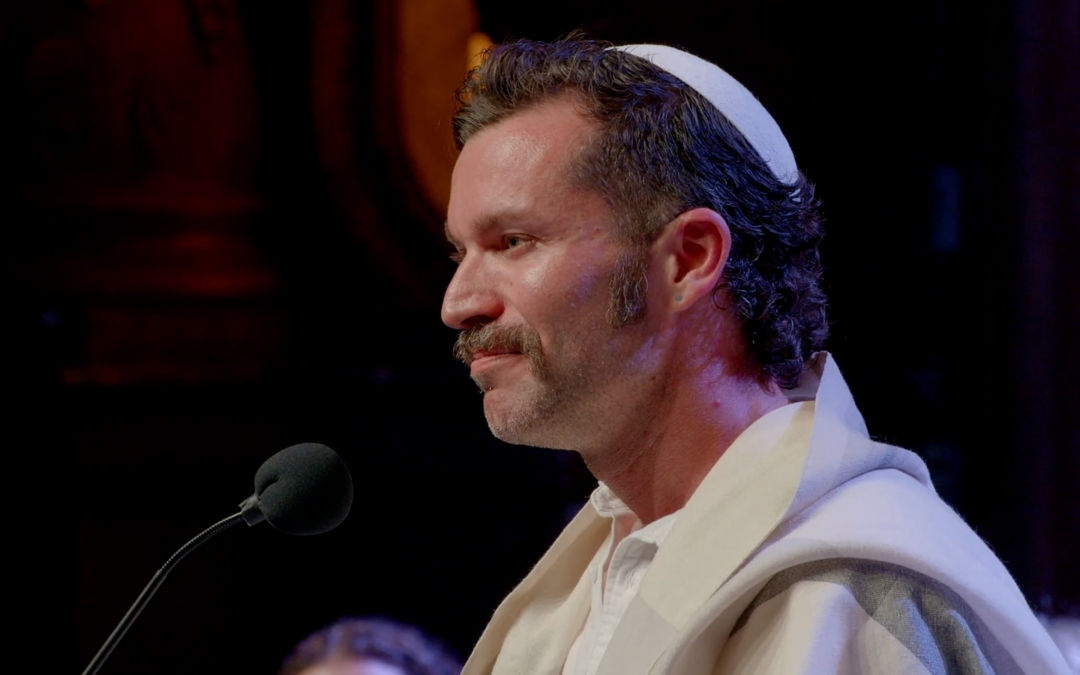
This sermon was delivered at our 5787 Kol Nidre service. You can watch it on our YouTube channel or listen on Contact Chai Podcast.
****
On the first Yom Kippur (which we’ll read about tomorrow), Aaron, the High Priest, offered a sacrifice to atone for his sins, then the sins of his family, and then the sins of the Jewish people. This movement through concentric, expanding circles of responsibility becomes the model for our own confessional. Ashamnu, bagadnu, gazalnu, dibarnu dofi — we have been guilty, we have been unfaithful, we have stolen, we have cast aspersions. For the next twenty four hours, we come back to this refrain again and again. The first time we look through this list and think about where we have missed the mark. What do I feel guilty about? Where have I broken trust? Have I stolen — not just things, but time, energy, and attention from the people and places where they belong? When have I been careless with my words?
But once that work is done, as we read through this litany of sins a second and third time, we slowly expand our circle of responsibility: even if I didn’t do something, how have I contributed to an environment where it happens? When have I tolerated bad behavior from family and friends? When have I met the failures of my community or my country with silence? When have I chosen to look away from far-off problems, using distance as an excuse for indifference? And so today (and on every Yom Kippur), we return to this confessional to take accountability for our role in participating in a world where these sins remain perpetually relevant. As Rabbi Abraham Joshua Heschel reminds us: while some may be guilty, all of us are responsible.
And so I think there is a reason that our tradition, on the day when most of us are sitting next to (or tuning in with) the most Jews that we are going to see all year, has us collectively beat our chests. Because this is our community. Whether family, friend, or neighbor, these are the people we shape and the people who shape us. Even if some of you are meeting each other for the very first time, there is a sense of “we” in this room — defined not only by geography but by a common identity, a shared value set, a mutual sense of obligation to build a better world. It’s more than culture, although that is important too. It is a brit, a covenantal relationship between Jews and the Source of All Things. It connects us, as a people, across time and space; the rabbinic imagination pictures the soul of every Jew past, present, and future (including converts, like myself) there at the foot of Mount Sinai to say “yes” to the covenant inscribed by Moses on those two stone tablets.
And because of that moment of communal assent, the rabbis teach: kol Yisrael arevim zeh ba-zeh, the entire people Israel is mingled together — both in the sense that we share a story, stretching back millennia, but also that this shared story connects us, brings us together, and makes us mutually responsible for one another because what one Jew does affects us all.
If Jews are a family, then the covenant is our birthright — and whether born or adopted into this people, each of us inherits the obligations and the privileges of this bond. The familial feeling rooted in this covenantal relationship has moved us to profound acts of charity for people we don’t know and places we have never been, raising funds to relocate Soviet Jewry or create institutions like HIAS, Jewish Child and Family Services, the JUF — which now serve people of all backgrounds, but were started to help Jews find their footing in this country at a time when most doors were closed to us.
Yet despite this history, it seems that Jews increasingly feel estranged from one another — if not discovering that we’ve become complete strangers. And so lately, I’ve found myself wondering about this collective “we” that once bridged distance and difference, and whether it exists anymore. This rupture is easiest to see between American and Israeli Jews, although even the diaspora — if we can call it the (singular) diaspora anymore — feels fragmented between the United States, Canada, Europe, and all other places Jews call home. The past three years have highlighted fundamental differences in what we believe to be true, although this gap was already growing before the tragedy of October 7 and its terrible aftermath.
The journalist Yossi Klein Halevi argues that this estrangement was inevitable, given our drastic differences in context. “Israelis have to be tough,” he observes. “American Jews have to be flexible.” Israel is a country constantly at war, both on the battlefield and in the arena of public opinion. Every Israeli I have spoken to in the past few years believes that they are in an existential crisis; the primary difference between those on the right and those on the left in Israel is who they believe embodies the greatest threat to their continued existence. And in the United States, Jews are a minority who have worked hard to be accepted by our neighbors — balancing our success with appropriate deference to those around us, knowing that our safety relies on collaboration and compromise with others. As a result, it’s beginning to feel like we no longer have the common vocabulary or shared experience necessary for relating to each other.
Now the Atlantic Ocean is not the only border that cuts across kol Yisrael. Here, as elsewhere, Jews are divided between the conservative right and the progressive left. And while most American Jews are Ashkenazi, we know that the global majority includes Sephardic, Mizrahi, Ethiopian Jews — all with different mother tongues and cultural traditions. There are fundamental differences in our understanding of halakhah and ethics — and even though the labels of Orthodox, Conservative, Reform, etc. are useful, there are hundreds of ways those communities can be further disassembled. We are, as the Torah describes, an erev rav: a mixed multitude of birthplace, ethnic background, religious commitment, and political affiliation. This isn’t a recent phenomenon; we’ve been like this since Sinai.
And like today, the Jews who came before us didn’t always get along. Disagreement is part of our spiritual DNA. Our tradition lifts up Hillel and Shammai, two sages who lived in the last century BCE. They argued about everything. And while there are only a few debates recorded between the two men themselves, they founded competing schools of thought whose students disagreed hundreds of times (there are over 300 on record). These weren’t trivial debates. These were arguments about real, substantive issues like Jewish status, observance, and expression to help us navigate a world on the brink of disaster. Each believed their way was the only way that could ensure our survival. We’re told that the division between them grew until na’aseh Torah ki’shtei Torot, the Torah became like two Torahs.
Now these rabbis were also part of the covenantal relationship that had coalesced us as a people, a fact they took seriously. But their differences could have been sufficient cause to redefine who was included in that agreement of collective responsibility. These debates were happening in the midst of incredible destruction, as the rabbis tried to remake our tradition in response to a precipitously hostile world. The very future of the Jewish people felt uncertain. And so one answer could have been cutting off the parts of our community that were difficult or disagreeable, to ensure a united front against whatever came our way. It was at this moment in history that the schools of Hillel and Shammai could have split (they already had a model of that kind of rupture with a newly emerging Christianity); from two different Torahs, two different Judaisms.
A few months ago, I was invited to serve on the Jewish Engagement Council for the City of Chicago. These councils help City Hall understand the needs of different racial and ethnic groups that call this place home — Black, Asian Pacific Islander, Polish, Arab, Mexican, Native American. I am hopeful for the work we can do, bringing together Jewish leaders who represent the cultural, religious, and ideological breadth of Chicago Jewry. But because of this wide range, in our first few meetings there has already been a struggle over who speaks for “the Jews,” who among us gets to claim the “we” that Mayor Johnson and his administration should listen to.
Take our feelings about the State of Israel, for example, which has either stressed or strengthened our relationship with City Hall — depending on which Jew you ask. Everyone has their favorite statistic to demonstrate their authority on this topic. Did you know: eight in ten American Jews say supporting Israel is an important part of being Jewish (Pew). But six in ten say Israel has committed war crimes (WaPo). Nearly 40% of American Jews identify as Zionist (JFNA). But one third of young Jews identify as anti-Zionist or non-Zionist. And so on. In claiming to speak for the Jewish mainstream, the not-so-subtle implication is that those who are not part of this “we” should not be taken seriously, if they should have been invited to the council at all, since they represent a dangerously misguided (if not outright dangerous) perspective. The fear is that allowing the other, whoever that is, to claim authority on our behalf could spell disaster for all Jews.
And if we are so different, if what we believe is so irreconcilable and how we behave so repugnant to one another — are we really part of the same covenant? How far does our circle of responsibility extend?
Let’s be honest, in recent years there have been more than a few Jews whose behavior has reflected poorly on our people — and whose actions beget consequences that we all bear, sometimes at great danger to our wellbeing. In Israel, leaders like Benjamin Netanyahu, Bezalel Smotrich, and Itamar Ben Gvir fuel the machines of war with an expansionist, messianic fervor. And at home, American ethnonationalist aspirations are championed by politicians like Stephen Miller who work on behalf of an administration that uses the excuse of Jewish safety as a tool for authoritarian control, while influencers like Ben Shapiro or Chaya Raichik capitalize off of hatred for the most vulnerable and marginalized. And then there are people like Jeffrey Epstein, who play directly into the worst antisemitic tropes of money, power, and abuse.
It is easy to point my finger at the right, because they are the people in power right now — and power, unchecked by the moderating forces of other perspectives, allows our worst impulses to be acted upon with devastating consequences. But I have also felt shame as a member of the left, and the embarrassingly simplistic, black-and-white rhetoric that has taken hold in progressive circles.
I imagine each of us has a list of Jews whose beliefs and behavior run so counter to everything we love about this tradition, we wonder if we’re even part of the same people. I have mine. And I know for a fact that I’m on someone else’s list.
And yet, because we are all Jews, we are so often called to account for their behavior — no matter how much we disagree with them, no matter how much we repudiate their actions. Those of us in this room understand that we are an erev rav, a people made up of many kinds of people; the boundaries of belief, affiliation, and ethnicity that divide one Jew from another are sharp and they are clear. At least to us. But in the court of public opinion, most folks just see a Jew. And to them, what one Jew does in our name becomes representative of our collective will. I hesitate to wear my magen David in public, remembering all the times I have been forced to prove that I’m the “right kind” of Jew — guilty by association until I sufficiently denounce whoever or whatever has provoked their indignation. There is no room for nuance or complexity in those conversations, rather a line in the sand that you must cross to be exonerated. Do you stand with Israel or do you support Palestinians? Is anti-Zionism always antisemitic or is it never antisemitic? Who guarantees Jewish safety, the right or the left?
And then, of course, there are the antisemites who don’t care about whether we’re the “right kind” of Jew, but seize the opportunity to act on their hatred under the guise of otherwise righteous causes. Antisemitism has cast its corrupting shadow across the political spectrum; it is a problem on the right and and it is a problem on the left. But in the end, it doesn’t care about where you stand or who you voted for; it lashes out indiscriminately, leaving Jewish communities changed forever — whether at Temple Israel in Michigan, or Tree of Life synagogue in Squirrel Hill, or the families celebrating Hanukkah at Bondi Beach this past December. I am always looking over my shoulder, no matter where I am.
To be clear: antisemitism is not a problem we created. The people responsible for antisemitism are the people who feel it, feed it, and act on it. But we certainly don’t need to be giving them examples of Jews behaving badly, especially when those Jews do something that runs counter to our own moral compass. Nor do we need to be giving our allies reasons to abandon us at this very vulnerable moment, by allowing ourselves to be affiliated with Jews that they (and we) find reprehensible. And so it can be tempting, and understandably so, to redefine who belongs to the “we” of our community. Why should we include Jews who violate the fundamental principles of our covenantal obligation within our circle of responsibility? In each of these cases, only some are guilty. Perhaps they should also be the only ones who are made responsible, forced to bear the burden of their choices on their own.
The opening salvo of Yom Kippur, what we just heard a few moments ago, is a formula annulling vows that we can no longer keep. Kulhon y’hon sharan, shvikin, shvitin, b’teilin um’vutalin, la sh’ririn v’la kayamin, all of them undone, abandoned, cancelled, void, neither in force nor in effect. Perhaps the promise of kol Yisrael, of a Jewish “we” that extends across our dissimilarities, is a promise we can no longer sustain. Yes, we all stood together at Sinai. But clearly our understanding of what happened there, and how we have been shaped as a people since, is no longer a matter of small differences. This bond has become too painful, a connection that breaks our hearts and crushes our resolve under the strain of maintaining it. Sometimes it feels like we stood at entirely different mountains, that the Torah is in fact ki’shtei Torot, two Torahs, incompatible and irreconcilable.
In the years leading up to the destruction of the Second Temple, the razing of Jerusalem, and our exile from the Land of Israel, competing factions emerged within our people: those who felt that we should seek a diplomatic solution to Roman imperialism and those who wanted to resist occupation at any cost. Each felt the other would lead us to disaster. Eventually faction turned against faction, and our people fragmented — refusing to work together for our survival, believing the other deserved whatever was coming to them. Tomorrow we will read a long section about the Temple service; it’s not there to bore you. It is intentionally included on this day to remind us of the incredible loss that we experienced at our own hands, the sacred pageantry of the Beit Ha-Mikdash sustained over centuries erased in just a few short days. The Romans may have destroyed the Temple. But the rabbis are clear: narrowing our circle of responsibility, allowing hate and distrust to replace mutual obligation, is what weakened the walls and threw open the gates.
So what if we could have told a different story? As the Romans laid siege to Jerusalem, those who believed that resistance was the only way forward burned the granaries that were sustaining the city. These zealots hoped that desperation would drive more Jews to take up arms and fight against Rome. Instead, famine descended on Jerusalem. Hunger drove people to harden their hearts; those who favored diplomacy refused to pick up their weapons, while those who wanted war killed anyone who tried to leave the city to speak to the Romans outside their gates. Finally, Rabbi Yohanan ben Zakkai arranged a secret meeting with the leader of the zealots, Abba Sakarra. Abba Sakkara was his nephew, showing that ideological differences had not only broken apart our people but divided families as well.
Speaking to each other, they realized that self-righteousness and finger pointing wouldn’t save them; when the city burned, it would consume them all. It didn’t matter who encouraged or who opposed this path drawing toward its inevitable end. They would live or die together. But what can I do, Abba Sakarra asks, if I challenge the zealots now they’ll kill me. Divided into factions, time had only made them more extreme — even though they were all driven by the same concern for Jewish survival. Forgetting this shared goal, their circle of responsibility had contracted to its narrowest point so that anyone who was not with them was against them. And I owe it to Rabbi Sharon Brous who posed this question just a few days ago on Rosh Ha’Shanah: what could have happened if the conversation between Rabbi Yochanan ben Zakkai and Abba Sakarra had occurred years earlier, when their factions still thought of the other as part of the same people concerned about and responsible for each others wellbeing?
We are at that moment, right now. We can decide to hold on to that sense of “we” — or we can abandon it. But history has taught us that we will sink or swim together. The covenant that binds us to one another may feel like an anchor dragging us down, but it can also be the raft that keeps us afloat.
Part of our covenantal inheritance is a shared value set, common to all Jews. As much as I hate to admit it, the people on my list of Jews behaving badly are also pulling from parts of our tradition — perhaps in ways I do not agree with or entirely understand, but our tradition nonetheless. Rabbi Eliezer once taught that if all the seas were ink, and every reed a pen, and both the heaven and earth were made of parchment, there would still not be enough space to write down all the wisdom contained in the Torah. How could any one person claim to know its limits? Every Jew draws from the same sacred texts, the same story of a small people who grew into a great nation despite slavery, wandering, and war — but how we interpret that history, what moral imperatives we derive from it, is filtered through time, place, and individual experience. This is the adaptive genius of our tradition. That same value set, how we interpret those values, and how we prioritize them can lead us to very different conclusions as we respond to new, often unexpected circumstances.
Take particularism and universalism, which exist in dynamic tension throughout our tradition. For a person driven by particularism, they might argue that Jews have to take care of Jews before anyone else. As the sage Hillel taught: if I’m not for myself, who will be? We are a small people, and one that is often the target of undeserved animus, and so continuity, safety, and communal integrity must be prioritized — even if it comes at the cost of greater isolation from the rest of the world. Yet for a person who values universalism, they might feel our greatest call is to be in service of the other; after all, we know what it is like to be a stranger in a strange land. They lift up the second half of Hillel’s teaching: if I am only for myself, what am I? This person might push for solidarity with other marginalized communities, deeper integration into the social fabric of society, and embracing our identity as a diasporic people — even if parts of ourselves are lost in assimilation. Both of these are Jewish responses, in conversation with the same values. It is a value set that includes: justice, loving-kindness, preservation of life, repairing the world, the pursuit of peace, a relationship with the land of Israel, tradition, adaptation, and the bold assertion that all human beings are created b’tzelem Elohim, in the image of God. These are the things that bind us, that give us a common identity and shared purpose; the creative challenge of our tradition is that each Jew interprets and expresses them in radically different ways.
This is not to say we can’t set boundaries. Many years ago I decided that I don’t pray in non-egalitarian minyanim, spaces where anyone who is not a man can’t lead services. That is not my Judaism. But it is still Judaism.
You’d be right to say: that’s an easy example. The extreme cases are much harder, when what a Jew believes or how a Jew behaves feels like it falls outside our shared value set or runs counter to our tradition entirely. It is precisely in those moments that the covenantal bond calls us toward one another, rather than allowing us to push that person away. Throughout the High Holidays, we picture God sitting on two thrones: one is din, judgment, and the other is rachamim, compassion. We can and we must hold each other accountable, particularly when our beliefs and behaviors cause harm. Those who encourage war, those who work to dismantle democracy, those who stoke the flames of hatred must be brought to account. But part of that accounting is the recognition, on our part, that we are all in this together. And while we may not have a direct line to those in power, we do have the ability to speak to the people closer to us — our friends, family, colleagues, co-workers, and neighbors. Proximity is an opportunity and an obligation.
For all their differences, the students of Hillel and Shammai could have abrogated their covenantal promise to one another. But they didn’t. Instead of isolation, they chose intimacy. We’re told that no matter how appalled they were by the other’s opinion, no matter how deeply they disagreed, the students of Hillel and Shammai still allowed their children to marry one another — and attended the wedding in joyful celebration, breaking bread together and joining their hands to dance.
I’ve come out to my family twice: once as queer, once as a Jew. And both times, a lot of folks in my family didn’t react well. But we chose to stay close, even as it strained our capacity for patience and understanding. It wasn’t easy. And there were moments when I considered cutting them out of my life. Maybe they felt the same way. We still don’t agree on most things: we are of different faiths, our politics are in opposition, we have divergent understandings of how to solve the world’s problems. But if we dig down, our values are actually the same: love, generosity, grace, helping those in need, and showing up for one another in celebration. And now, they welcome my partner at family events. They participate in my Judaism, when it overlaps with our time together. It’s not a perfect ending, it’s still hard sometimes, but it is a better one than what would have happened if we had just walked away from each other. And all of us, through the choice to keep one another within our circle of responsibility, have changed: we are more tolerant, more intellectually flexible, more emotionally resilient.
We cannot solve the problems of this world by wiping our hands clean of other people and their actions, because we are bound by gravity to the same fate as everyone else on this planet. There is no solution, whether global or local, that does not require all of us. And so an essential component of encouraging teshuvah, of repentance and repair, is understanding why individuals make the decisions that they make. There are values that are particular to our people, the Jewish people, and there are values that are universal: safety, shelter, connection, community, a sense of purpose, living lives of meaning. Once we understand what someone values, and how they interpret those values, and where we are both speaking from the same foundation, then we can have the kinds of conversations that change us and our world for the better.
And so this is my blessing and my desperate plea to each of us, as hard as it can be sometimes (and it is hard): do not allow your heart to lose space, contracting your circle of responsibility to only include the people who think and act most like you.
Like Aaron, the High Priest, we begin with the self and we move outward. How would you act differently toward other people if you felt responsible for their moral development and wellbeing? Begin with those closest to you, your friends and family. Honestly, these are often the hardest conversations because they share your values, but may interpret and prioritize them in ways that confound you. So ask questions: the kind that are for deeper understanding, not for trapping or convincing. Figure out your shared value set — and listen to how they interpret and apply them. Find out what experiences led them to their views. The rabbis tell us to make for ourselves a heart of many rooms. Begin building the scaffolding that will allow you to have these kinds of conversations with people outside your closest circle, so that your heart is resilient and capacious enough to hold even greater differences — and still show up with care and compassion.
This may not seem like much in a world on fire. But connection is the balm to hatred, a lesson Jews learned two thousand years ago when we were nearly destroyed as a people. We can choose rupture, or we can choose repair — but we are running out of time. The walls are crumbling. The gates are swinging open. That choice, for all of us, is now.
G’mar chatimah tovah, may we all be inscribed for good.